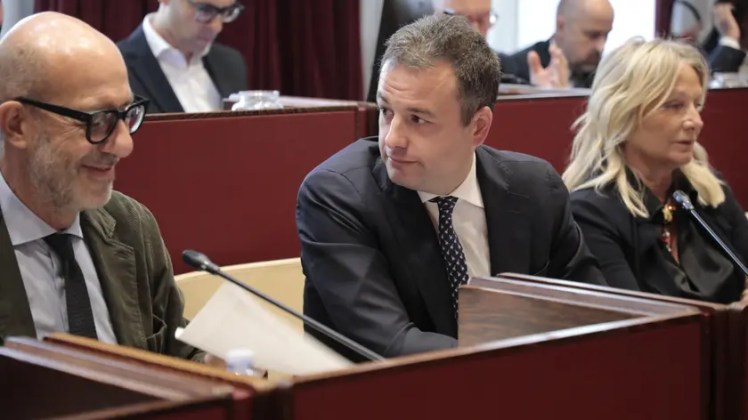
During the vote on the 2026–2031 policy guidelines, an amendment by Marco Gasparinetti to extend the ban on changes in property use to include Giudecca and Murano was approved. Venturini outlined his administration’s priorities: refinancing the “Special Law” for Venice, addressing housing, enhancing security by adding 200 municipal police officers, and increasing the tourist access fee.
Mitia Chiarin
October 16, 2026
Three months into his term, Simone Venturini returned to the City Council to deliver his first substantive policy address, and it brought some unexpected developments. Among them is the expansion of the “hotel moratorium” (a ban on converting existing properties into hotels) from the historic center to the islands. During his speech—part of the vote on the 2026–2031 mandate guidelines and the Single Planning Document (DUP)—Venturini made his intentions clear.
“This is not a taboo subject; I will have the relevant departments get to work on it.” His majority then took action: out of nearly a hundred amendments proposed by the opposition, one was passed—the proposal by Marco Gasparinetti (Terra e Acqua), who is now claiming victory. In just a few words, the councilor had called for “extending the ban on changes in property use to include Giudecca and Murano.” The amendment immediately imposes stricter controls on the opening of new hotels, a trend currently causing significant strain in Giudecca (notably at the former Scalera site) and Murano (where three massive cranes have appeared at the former Ferro glass furnace to construct a large hospitality complex).
Venturini’s message
The episode surrounding the “hotel moratorium” speaks volumes about Simone Venturini’s strategic approach in dealing with the opposition. He appeared before the council, reiterating that his administration represents a break from the past. “My commitment is free from personal agendas or careerism. My sole objective is to secure as many results as possible for Venice; revitalizing parts of the city, addressing long-standing issues, and creating better conditions for those who live here,” he stated. He acknowledged—and rewarded—signs of openness (in this instance, from Gasparinetti) but clashed with the Democratic Party (PD). “You challenge me to accept your proposals, provided they are sensible and sound; I, in turn, challenge you to provide an opposition that isn’t driven by ideology. Some of you have done so today, while others are still running an election campaign.”
A confrontation ensued with PD Senator Andrea Martella, whom he defeated in the election. Martella recently labeled Venturini an “influencer mayor,” criticizing his lack of strategy and the absence of any clear direction regarding the refinancing of the “Special Law” for Venice, public safety, and the city’s special statutory status. Venturini retorted: “Senator, I won’t even mention your own absence from the city’s public discourse over the last 25 years.”
Meanwhile, Michele Zuin took on the role of the “bad cop,” rejecting the amendments put forward by the Democratic Party.
The Mayor’s Priorities
Venturini outlined his priorities. “The first concerns Venice’s role in Italy and the world. Venice must further strengthen its international relations,” he explains. It should be not only a global capital of art and culture but also an open city that can leverage its “soft power” to attract “investments in specialized sectors with higher added value.”
He continued: “The goal is to build an additional pillar for the Venetian economy alongside those already in place that is capable of generating new opportunities and helping to raise the income levels of our citizens. This means attracting investments, ideas, and talent, while working closely with the academic world and aiming to bring in new international university institutions.” He also highlighted healthcare, focusing on the recruitment of medical staff and the development of the new community health centers. Housing is another central issue.
“We have proposed to the Regional Government a more unified approach to the management of residential property. The experience gained in Venice with social housing is a model that the Region itself is now looking at with interest and attention. We are also working with the national government to ensure that Venice remains firmly at the center of national-level discussions—not just with the current administration, but with future ones as well. Venice cannot be viewed merely as a city that asks for resources, even though it bears extraordinary costs due to its unique nature.”
The Special Law
Furthermore, he called on the opposition to collaborate—60 years after the 1966 flood—on a “major national and international mobilization, followed by a renewed ‘Special Law’ for Venice; we must bring this issue back to the heart of the agenda. The primary objective is the refinancing of the Special Law, but I believe it is also time to begin a comprehensive process of updating and strengthening it.” Then, there is urban regeneration: “We must repair parts of the city, restart construction projects, attract investment, and bring high-quality development to the municipal area, while also experimenting with public-private partnerships capable of generating new opportunities.”
He mentions the new call for proposals for the reuse of commercial spaces, aimed at breathing new life into urban areas by removing bureaucratic hurdles. Regarding public safety, he reaffirmed his commitment: “By the end of my term, I will leave the city with 200 additional police officers. Fifty will be hired within the year, with further competitive selection processes to follow over the next three years.” He confirms the expansion of Parco Piraghetto; the enlargement of San Giuliano Park into the salt marshes toward Campalto; the opening of the library in Marghera; the redesign of the central areas, from Piazza Mercato toward Sant’Antonio; and the revitalization of the city’s historic forts. On the subject of tourism, he reiterates that the entry fee must be increased to help fund projects for the city: “We need to refine our approach by focusing on quality: attracting long distance travelers, longer stays, and visitors who are genuinely interested in cultural treasures and getting to know the city.”
Source: La Nuova di Venezia e Mestre
Don’t miss a story! Subscribe to receive news from Venice by email: