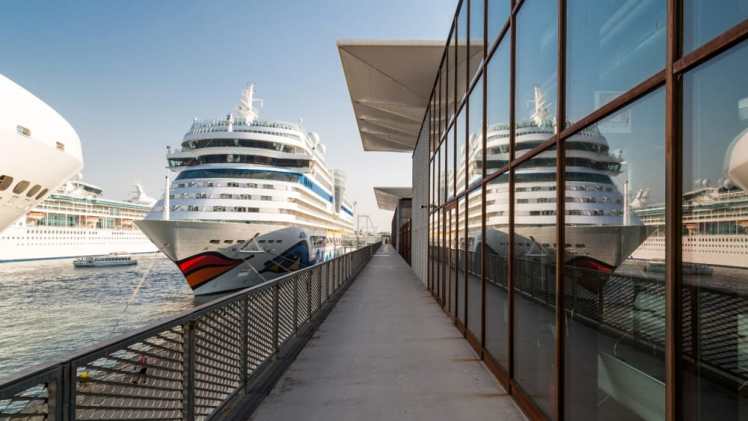
The future passenger terminal in Marghera and the dredging required to ensure the navigability of the Vittorio Emanuele III and Malamocco-Marghera channels have been approved. Port operators urge: “No time to waste now.”
September 27, 2026
Editorial Staff
The ministerial commission responsible for carrying out the EIA (Environmental Impact Assessment) and SEA (Strategic Environmental Assessment) has issued a favorable opinion on the three projects proposed by the Commissioner for Venice Cruises: dredging the Vittorio Emanuele III channel, constructing the new passenger terminal in the North Channel (Marghera), and dredging the Malamocco-Marghera channel.
This marks a significant step in the port’s evolution, affecting both the cruise sector and commercial operations. The Malamocco-Marghera channel is the port’s main artery; this maintenance project will allow for increased draft depths and also includes the creation of 100 hectares of new salt marshes and mudflats. Dredging the Vittorio Emanuele III channel will enable the maritime terminal in Venice’s historic center to be used again; under the Port Authority’s plans, this facility will serve smaller luxury vessels, which will be able to keep their engines off while docked thanks to a new “cold ironing” (shore power) system.
Larger vessels—up to 300 meters in length—will dock in the Marghera North Channel, where the new passenger terminal is to be built. These vessels will also utilize the cold ironing system, funded by the NRRP (National Recovery and Resilience Plan). The goal is “a new cruise model,” emphasizes Matteo Gasparato, President of the Port Authority and Special Commissioner, “and it is significant that this path has received such clear environmental validation. The work will be carried out in compliance with strict requirements, utilizing a continuous and transparent monitoring system. The direction is clear: Venice will not return to having large ships pass in front of St. Mark’s Square. We want a different kind of cruise industry, with traffic flows and vessel sizes that are compatible with the city and the lagoon.”
Environmental Protection
The conditions set by the approval process strengthen the environmental protection framework: the projects must ensure the reuse of sediments for the morphological restoration of the lagoon, as well as turbidity control. Also required are monitoring of the seabed and wave action, protection of local habitats and species, air quality measures, and monitoring of the impacts of navigation. The next phase will be the drafting of detailed engineering designs.
In addition to these interventions, there is the new sediment disposal site (“Tresse 2”)—authorized by the EIA (Environmental Impact Assessment) commission last October—for which the detailed design has been completed and the call for tenders is set to be published shortly.
The news was welcomed by Davide Calderan, President of the Venice Port Community. “Infrastructure development must go hand in hand with the protection of the lagoon. Two berths on the North Channel, a terminal for disembarkation operations, and the restoration of the seabed in both channels will allow the Port of Venice to regain some of the cruise capacity lost following the operational changes in 2021.” Now, “it is important not to waste any time.” According to Paolo Bonafé, coordinator of the Union of the Centre (UdC) in Venice, “after years of discussions and stopgap solutions, Venice must succeed in building a model that balances economic development, employment, port functionality, and preservation of the lagoon. Large ships must not return to the waters in front of St. Mark’s Square, yet at the same time, we cannot abandon our city’s historic role as a port.”
The association AmbienteVenezia holds the opposite view, pointing out that the announcement was made prior to consultation with the Ministry of Culture. In a letter sent to the Minister, the association notes that “the proposed plans—which would allow large cruise ships to enter the lagoon via the Malamocco Inlet—circumvent the ban on transit through the Venice Lagoon established by Decree-Law No. 45 (converted into law in 2021).” Furthermore, the association highlights the “insufficient regard for the risk of accidents along the Malamocco-Marghera Canal caused by the exposure of the large ships’ hulls to prevailing winds.”
Source: Venezia Today
Don’t miss a story! Subscribe to receive news from Venice by email: