
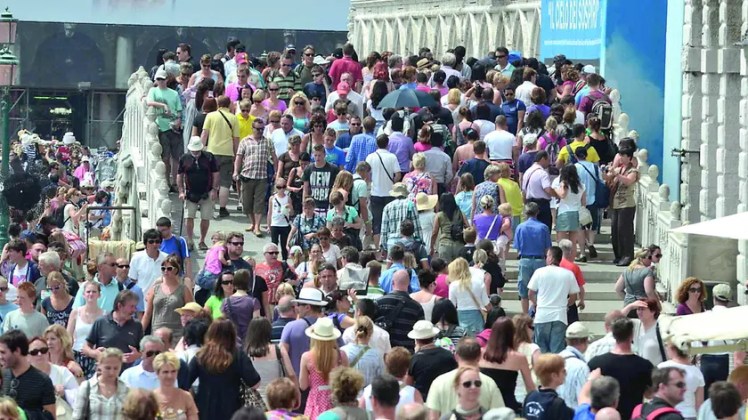
Combating mass tourism will be one of the new administration’s main challenges, in the difficult balance between freedom of enterprise and the protection of a very fragile city.
By Costanza Francesconi
May 13, 2026
In Venice, the label as the capital of overtourism seems to have come to define the city like an indelible tattoo. Tourism is an extremely difficult phenomenon to govern, some in the city would even say eradicate: it is the blessing and bane of the lagoon capital.
Mass tourism: shadows and light
With billions in income produced each year, the city’s primary economy, tourism (or overtourism?) feeds a paradoxically invisible supply chain. A delta that even makes ends meet for the baker, who is still active in the historic center only because, by 7:30, when he opens the shop, he’s already delivered fresh bread to the hotels.
The greengrocer did the same. The laundromat, often based on the mainland, delivered clean linens. Everyone relied on transporters, another link in the chain, rushing to their topes, and then on to carts and legs, closing the circle by pulling goods on foot.
But overtourism is the same thing that compresses the living space of residents, many of whom have fled the historic center. Artisans suffer, silent creators for an indifferent public; young people have limited prospects for professional opportunities in the city; the elderly are jostled on the bridges; the lagoon is congested and polluted.
Those with a tourism-related business, however, turn a blind eye. Then, when Venice can’t breathe because of what their sector brings in, they escape to the mountains or hills.
So, is Venice a brand? What does it sell? Has it produced or is it suffering from overtourism? And who benefits from this overtourism? To try to answer this question, we gathered the opinions of those most directly involved. “It’s a tough nut to crack for the future mayor,” some responded, saying “it’s all the fault of day-tripper tourism, which the access fee, the ticket signed by the Brugnaro administration, has been trying to regulate since 2023.”
Venice’s Tourist Guides
Carlotta Vincenti, president of the Venice Tourist Guides Association, a group of 130 professionals, all Venetian, calls for courage. “The access fee is the city administration’s first attempt to acknowledge the problem,” she concludes, “but now politicians need to evaluate the legislative tools available and determine what restrictions can be imposed. As a professional group, we are not opposed to establishing a maximum limit of visitors for the city.” This suggestion has been repeatedly raised by former mayor Paolo Costa.
“In Greece,” adds Vincenti, “125 localities have banned the installation of umbrellas on the most sensitive beaches. As tourism operators, we partly create the crowd,” the guide clarifies, “but we feel a strong need for regulation. We will continue to discuss this with the new administration; it will be essential to team up with representatives of other national associations active in the city.” Among the actions taken so far is lowering the maximum number of visitors per group to 25, “to be extended to school groups as well,” and an image: “The pressure of the increasingly marked residential tourism across the 6 square kilometers of the island, with tourists sleeping in short-term rental apartments.”
OCIO: Impact on Residential Life
According to the Civic Observatory on Housing and Residential Life (OCIO), overtourism clogs the streets and erodes the housing stock, only enriching the pockets of property owners, their doorbells put on the tourist residential market. “On April 11, 2023, the historic center had 49,365 residents and 48,596 tourist beds, both in hotels and non-hotel accommodations. On April 20,” recalls Francesco Penzo from the Observatory, “these numbers rose to 52,541, a total of four thousand more in three years, the result of a lack of regulations that could have been adopted in Venice, a moratorium, and the systematic “circumvention” of the resolution blocking new hotels. Even if depopulation in Venice has distant roots and contributing causes, the sheer difficulty in finding housing is a big contributor.”
ABBAV: Damage to Venice’s image
ABBAV, the trade association representing operators of tourist rentals, B&Bs, guest houses, and other non-hotel accommodations, distances itself from the accusations. “We, who are blamed for the problem, are the first to suffer the damage to Venice’s image as overwhelmed by tourists and therefore unlivable,” snaps President Ondina Giacomin (ABBAV Veneto). “Overtourism,” she points out, “is only good for junk souvenir stalls, bars, and restaurants. No one else benefits. It will exist as long as there are low-cost flights, buses, trains, ships, and luxury cruise ships from the coast, all heading to Venice at low cost. My proposal is to eliminate the tourist tax and raise the entrance fee, tying it to a service card, like in New York,” she suggests: “One hundred euros a day, 75 for two, rewarding those who sleep in the city. This includes museum admission, and the use of public transportation and public restrooms, which need to be upgraded.”
AVA: Higher quality of offerings
“Increase the quality, reduce attendance. But before we talk about overtourism, let’s manage day-trippers better.” Daniele Minotto, director of the Venetian Hoteliers’ Association (AVA), speaks frankly. To provide a clear picture, he cites the data on tourist beds: “At the end of December 2025, there were 93,000 in the municipality, of which 60,000 were non-hotel—nearly 47,000 tourist rentals—and 32,800 were hotel beds. In the historic center, however, there were 20,300 hotel beds and 49,300 non-hotel beds, of which 46,000 were tourist rentals.” He returns to the decision made by hoteliers after the pandemic. “Since 2019, hotel capacity has decreased in an attempt to attract a high-spending clientele who are more respectful and interested in Venice. This would increase the duration of the average stay, which dropped below two nights for the first time last year.”
In hotels, despite major openings, the reorganization of spaces has prevailed. The average of 80 beds per facility has dropped to 70. “Fewer but larger rooms, and amenities like spas, boutiques, and restaurants.” This strategy has been undertaken by seeking external support for more refined management of daily flows. “70% of tourism revenue comes from just the 30% who sleep in hotels,” Minotto notes. He fully supports the entrance fee. In fact, he would extend it to Venetians as well. “As already outlined in the 1996 Benevolo Plan,” he then reiterates, “before limiting access to the city, it’s better to also open differentiated access points at Fusina and Tessera, Zattere and Fondamente Nove, not just Piazzale Roma and the train station. Only then will the assessment of attendance be objective.”
Taxi Drivers: “It feeds everyone”
Alessandro Gaburro of the Taxi e Nolo Uniti association, however, sees no emergency. Perhaps it’s because from the water pedestrian traffic seems less dense, or because those visiting Venice for the day rarely travel by motorboat. The fact remains that taxi drivers are experiencing “a workload that I would call normal, back to pre-Covid levels.”
This is nothing like the euphoria that mounted in 2022, 2023, and 2024.
“There’s great excitement only around the Film Festival, between August and September, and in April and May, when the Biennale opens. We hardly sleep these days; I apologize for my sleepy voice,” he says over the phone. “Everyone’s working these days. Even young people,” the taxi driver complains, “young people with private boats with LV plates, without licenses or POS on board, chauffeurs for one or more days paid by whoever hired them. The truth is that tourism, of all kinds, feeds everyone in Venice.”
The Candidates’ Proposals
In Venice, tourism continues to be both an economic resource and a central political issue. In the run-up to the elections, the issue of overtourism is included in the platforms of the eight mayoral candidates, all of whom will be confronted with a city that has been battling for years against the depopulation of its historic center, the pressure of short-term rentals, and the impact of daily tourist flows.
Center-right candidate Simone Venturini, outgoing Tourism Councilor in the Brugnaro administration, is pushing for administrative continuity. In his platform, combating overtourism involves more technological management of visitor numbers, increased access fees, and a greater distribution of visitors between the historic center, islands, and the mainland. Venturini also emphasizes the need to defend “quality” tourism.
Center-left candidate Andrea Martella is more critical of the model of the last ten years. The Democratic senator proposes a rebalancing of the inhabited city and the visited city: tighter limits on tourist rentals, incentives for residents to return, and a plan to bring local services and businesses back to the historic center. Martella links the issue of tourism to that of residential housing, arguing that Venice risks definitively transforming into a “postcard city” without residents.
On the environmental and civic front, Giovanni Andrea Martini is promoting a radical platform against mass tourism. His coalition, “Tutta la città che vogliamo,” calls for a cap on daily admissions, new restrictions on large accommodation facilities, and a halt to the expansion of short-term rentals in the historic center. Martini also proposes allocating a fixed portion of tourism revenue to the recovery of Venice’s public housing.
Liberal Michele Boldrin, on the other hand, approaches the problem from an economic perspective. For Boldrin, the real issue isn’t tourism itself, but the lack of an alternative economy. His proposal is to attract innovative businesses, international universities, and new professionals to reduce the city’s dependence on tourism monoculture. On a practical level, he advocates stricter regulation of short-term rentals and a variable pricing system for visitor access during peak periods.
Pierangelo Del Zotto, supported by Prima il Veneto, takes a more identitarian stance. Del Zotto links overtourism to the loss of Venetian identity and proposes tax breaks for residents and historic shops, as well as a crackdown on businesses that cater exclusively to day-tripper tourists.
Source: La Nuova di Venezia e Mestre
Don’t miss a story! Subscribe here to receive news about Venice by email!



Thank you for sharing and sending me e-mails, but I am writing to ask you to cancel this address and send me mails to the following in the future: dicat.g@gmail.com.
All the best,
Gina Di Cataldo
LikeLike
Hi Gina, thank you for being a subscribed reader. I can’t change your email address. Can you please re-subscribe with your gmail address? I will delete the other one from our list. Thank you!
LikeLike