
Venetian surnames have vanished, replaced by tourist listing plaques. Local shopkeepers say: “The entry fee did absolutely nothing”
By Costanza Francesconi
May 7, 2026
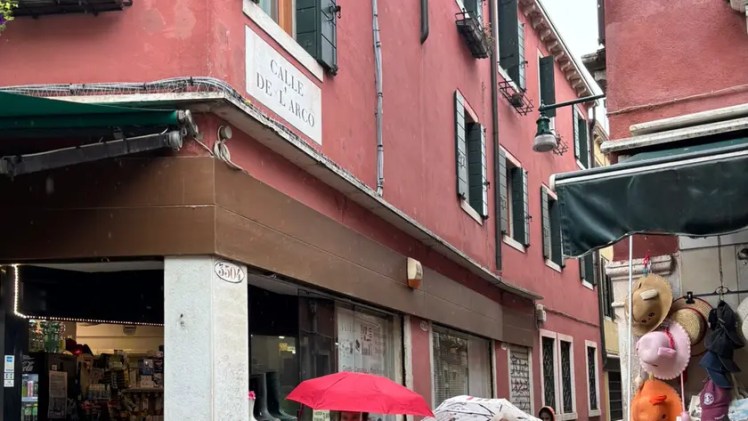
There is a street in Venice full of ghost residents. The houses are there, the roof tiles, the walls — but not the people. On the doorbells of more than half the addresses, tourist rental placards and their corresponding codes have taken over. On Calle de l’Arco — a side street off Salizada Sant’Antonin — letters and numbers that have gradually replaced the surnames of Venetian families. Hospitality has driven out residency.
THE TRANSFORMATION
Gone are the grandmothers with their shopping carts and grandchildren playing soccer or pièra alta on the nearby Salizada del Pignater. Gone are the chalk marks left by children on the paving stones of Campo Bandiera e Moro. Gone are the lines at the fabric shop or the fish counter, now a distant memory. The transformation is complete.
The city has lost its character, even in this part of Venice that some tourist guides still stubbornly describe as authentic. “And for what reason?” That’s what the few remaining shopkeepers ask themselves. “We’re holding on”, they tell each other, as if trying to keep their courage up. This is in the heart of Castello, steps away from San Zaccaria. The street in question, Calle de l’Arco, looks deserted at 10 in the morning on a weekday.
CHECK-IN TIME
“It comes alive at check-in time”, says a shopkeeper on Salizada Sant’Antonin. She says this with the resigned tone of someone who has gotten used to the new rhythms and can still offer some insight into her neighborhood. But when exactly is this elusive hour, given that more than one door now has an external keypad so guests can let themselves in on their own, around the clock?
“Usually around noon”, she explains, “just enough time to get from the airport to the city center. Then the first thing travelers do is go grocery shopping at the mini-markets that have popped up in the area over the past few years.” There are a handful of them within just a few hundred yards.
Thus, the scene plays out: rolling suitcases filing into the street, phones held up in the air searching for a signal, navigation apps confused by the maze of filled-in canals, waterfront walkways, courtyards, and dead ends. And inevitably the proverbial (or prophetic) saying echoes: ” Venice is beautiful, but I wouldn’t want to live here.”
THE DISAPPEARANCE OF NEIGHBORHOOD BUSINESSES
“I no longer recognize this place.” Martina Purisiol is an artisan. She has worked with ceramics in her shop on Sant’Antonin since 1986. Her creations have reached as far as the Vatican. “The zoning change for these commercial spaces has disfigured this street and Venice as a whole,” she says. “There used to be two furniture stores, three fishmongers, a jeweler, an electrician, a butcher, a grocery store, and a fabric shop — all gone.” In their place: ATMs and cramped little shops with windows packed full of souvenirs and cold drinks. The dry cleaner now works exclusively with hotel linens; most of the restaurants have changed hands or management, now Chinese, Bangladeshi, Albanian.
“The same happened to the gelato shop and the Alla Bragora bakery,” Purisiol recalls. “The large tour boats docking on the nearby Riva degli Schiavoni, and the explosion of short-term rentals in every square foot of livable space, have helped make the city accessible to everyone, and have dealt the final blow to this neighborhood.”
THE ENTRY FEE FLOP
Fleeting vacations, mass tourism, blank stares. “Entire tour groups walk right past”, the craftsperson continues. “They wear headphones, they look at you like you’re a platypus in a cage. There’s no sense of wonder at finding a workshop in a magnificent historic city. The people who buy my work truly understand and share the love for Venice that goes into it — nothing like the rampant sell-off happening all around.”
As for the tourist entry fee, it hasn’t even managed to serve as a band-aid. “Around here”, she says with a bitter shrug, “all it did was make people who paid it feel they’d automatically earned the right to use the restrooms in the bars.”
A NEIGHBORHOOD OF STRANGERS
At the bacaro “da Tiziano”, run by the Pengo family since 1961, Tiziano and his daughter Nicole work side by side. “Local customers have practically vanished — supermarkets have opened everywhere, and the clientele? All unfamiliar faces,” they say. Hard to expect otherwise in a place so hollowed out that its residents have become ghosts. This fear has surfaced in recent writing about the city’s future by economist Francesco Giavazzi, former mayor Paolo Costa, and professor Gianni Moriani.
The church of Sant’Antonin now hosts exhibitions for the Biennale. Still sitting vacant are the former Banco Lotto No. 10 — once a workshop run by women from the local women’s prison — and the former Bragorà, which until a few years ago was a showroom workshop run by a Venetian couple. Guccini once sang: Stefania is a child; buying and selling Venice will be her destiny.
Source: La Nuova di Venezia e Mestre

Don’t miss a story! Sign up to receive news from Venice in your email!