
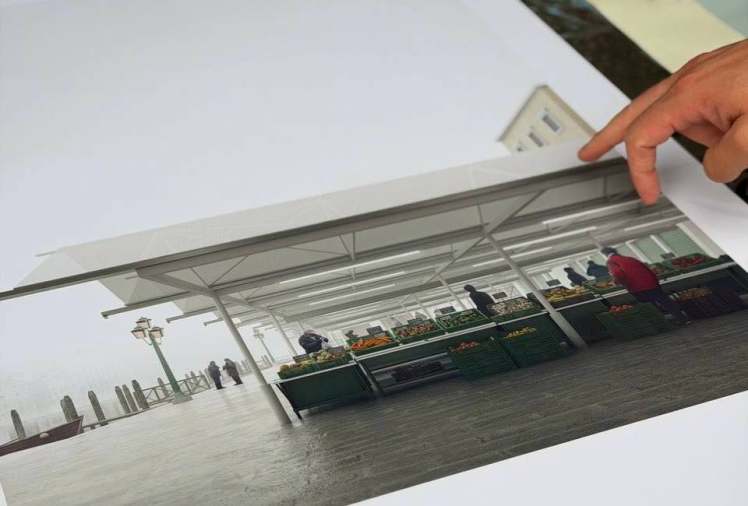
Starting in September 2026, work began on replacing the 24 produce stalls at the Rialto Market. During the work, the vendors have been temporarily moved to the Casaria area, specially vacated for the purpose.
Councilor for Commerce Sebastiano Costalonga recently reaffirmed, in an interview with Il Gazzettino, the intention to connect shopkeepers and merchants, creating synergies between those who sell fresh products and those who turn them into cooked dishes. The goal is to make the market not only a place to buy, but also a place of encounter and gastronomic experience.
Meanwhile, citing the contraction in traditional demand and the rise in tourist flows, the City Council approved a resolution allowing produce stalls to also sell products such as spices, packaged dried fruit, and vacuum-packed rice.
By Franco Migliorini
September 10, 2026
It has always the commercial and symbolic heart of the Venetians. Rialto with its market, where every morning people stock up on food. But the demographic decline in the historic city has left its mark on the market too. There are fewer and fewer food stalls, but more and more tourists wandering around to see what the Venetians do at the market. For quite a while now, and increasingly so, the traditional stalls include food souvenirs made from products coming from who knows where, watched over until evening by a line of vendors whose origin, by contrast, is well known. They are all non-Europeans, guarding prepackaged dry goods that someone has entrusted to them. Starvation wages for worthless products. But it serves to hold the locations.
For the Venetians this is decline, for others it is manna. Spaces emptying of Venetians means spaces filling up with tourists.
We find ourselves at the foot of the Fabbriche Nove of Rialto, a historic building recently emptied by the former courthouse, which has consolidated its activities at Piazzale Roma. The move was an ideal joining of Justice between two distinct cities, distant, but interdependent in everything.
For Rialto, it was an opportunity to rethink the role of the historic urban heart. What is missing is not space but ideas: how to reinterpret compatible functions for these spaces in a city like Venice? Is it possible to think of Rialto as a place of immaterial production tied to Venice’s historical and artistic tradition, but conceived for the digital age? Certainly it can for creative content.
However, on this front, the new administration is going along with the previous one. If anything, it is reinforcing its approach. What is emerging from the new administration is not a real “plan” for the future of Rialto, but rather new “little plans” tailored to the lobby of the licensed outdoor seating concessions. The one that does business by grabbing every public space, in order to turn places of history into places to eat. Always at mass-scale. From the brain to the stomach.
In the new administration, the very same councilor for public establishments as in the previous administration continues to pursue this logic, in perfect continuity with the past. He plays the dual role of direct representative and himself a protagonist of the Venetian spritz economy, oriented towards delighting the palates of visitors who, by day, and even more by night, sustain that form of urban life which has one of its epicenters in Rialto. That urban life is known for having produced a serious loss of residents in the entire area.
In place of the produce stalls, by now abandoned due to demographic desertification, there will be new restaurants, in an apparent logic of an evocative local symbiosis between the selling and the consuming of food. This formula has already converted a large part of the traditional bars into restaurants. No longer coffee and drinks, but only standard meals offered with the suggestion of traditional cuisine, yet produced by industrial methods – far more profitable.
This all fits very well with the reorganization now under way of the entire chain of public establishments, organized according to the chain of success: “Property landlord, investor for equipment, business operator, underpaid non-EU worker!” A well-organized rent-seeking model, easily associated with the standardized mass-catering supply chains produced on the mainland.
It is the most effective response to the mass tourism of day-trippers, who require the availability of urban space. And this is where the “little plans” come in, a synonym not of slowness but of administrative cunning. They are progressive tool through which the public space of outdoor seating becomes an essential component of the production process of tourist services, sized to the crowds in the historic city. It represents a vision of the city as a multiplier of profits, measured per square meter of outdoor-seating surface progressively turned into commercial public establishments.
While the covered surface of residential properties in the city corresponds to a related organization of the hospitality economy, the uncovered surface of outdoor seating corresponds to an equivalent form of restaurant economy.
Put together, the two things chase and structure the offering that the city presents to contemporary mass tourism. In any case, it is a figure that keeps growing. One piece at a time, with constancy and with patience; now it is Rialto’s turn. After all, if the Venetians are leaving, someone will have to take their place. Venice is hardly a dead city! If anything, it is an embalmed one.
Source: Ytali Global
Don’t miss a story! Subscribe to receive news from Venice by email:


 Campaign For A Living Venice