
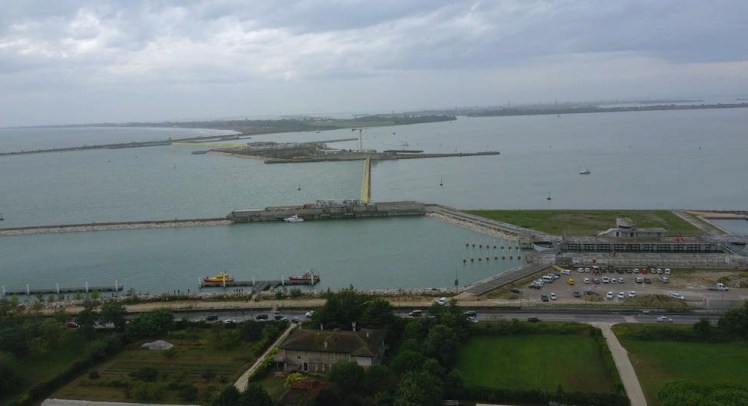
When it comes to the future of Venice’s preservation, we are no longer facing a mere administrative delay: instead, we are caught up in institutional and operational chaos in which jurisdiction, responsibility, and resources continue to bounce back and forth between Rome, the Provincial Education Office, the Lagoon Authority, Consorzio Venezia Nuova, and various companies. In this scenario, the Comune di Venezia is not merely absent, it has chosen to remain irrelevant.
by Giuseppe Saccà
August 11, 2026
With regard to the MOSE project and the future of Venice’s preservation, we are no longer dealing with a mere administrative delay: instead, we are caught up in institutional and operational chaos in which authority, responsibility, and resources continue to bounce back and forth between Rome, the Provincial Office, the Lagoon Authority, Consorzio Venezia Nuova, and private companies. Meanwhile, the work remains incomplete, the system has not yet been definitively tested and handed over, complementary projects are proceeding slowly, and dozens of workers do not know what their future holds. And the Comune di Venezia, which should represent the city’s interests, is absent.
The first sticking point is the Lagoon Authority. This agency was conceived to overcome the fragmentation that had characterized the management of the city’s preservation efforts for decades, and to provide Venice with a stable institution in which to centralize functions, responsibilities, and planning. Six years after its establishment (Decree-Law No. 104 of August 14, 2020, Art. 95), however, it continues to exist more on a formal level than an operational one.
Appointments, incomplete transfers of functions, staff shortages, insufficient resources, and constant delays have prevented the Lagoon Authority from functioning, leading to personnel who were previously assigned to the Authority returning instead to the Provincial Office. The paradox is clear: the body created to overcome fragmentation has ended up creating a permanent state of transition, while the center of decision-making is shifting back toward Rome.
This is not a dispute between agencies. The issue is political: who will govern the MOSE, who will plan maintenance and environmental interventions, who will coordinate complementary works, and who will be accountable for the decisions that are made – or not made?
Added to this uncertainty is that surrounding the completion of the work. MOSE is in regular use and has proven capable of protecting Venice from the highest tides, but the acceptance testing is not yet complete, and the transition to routine management remains contingent on the Authority becoming fully operational. Furthermore, there is an ongoing dispute, far from being resolved, regarding the completion of the work: the Consorzio Venezia Nuova attributes many delays to the constant changes in management that have occurred over the years; on the other hand, there are complaints about unfinished jobs, procedures still pending, and postponed deadlines.
We have thus built an infrastructure capable of functioning in an emergency without having yet fully defined its routine management. The contractors themselves complain of having advanced significant funds and that they have waited a long time for payments – a further consequence of administrative uncertainty that ultimately falls on those responsible for constructing and maintaining the facilities.
Yet the preservation of Venice cannot be reduced to simply raising the floodgates. The lagoon requires continuous maintenance, widespread environmental interventions throughout, local defenses, and long-term planning. The Europa Plan and other complementary measures should fit into this vision. Here, too, however, there is a lack of clear leadership: strategies are being re-discussed, projects modified, priorities shifting, and timelines extending. The law also requires the “Comitatone” [the Interministerial Committee for Venice, the Italian body charged with policy, coordination, and control over efforts to safeguard the city and its lagoon, Ed.] to submit to Parliament, by September 30 of each year, a “Report on the Status of Implementation of Measures for the Preservation of Venice”; there has been no word of this report for about a decade.
Amid this uncertainty are the workers: technicians, laborers, engineers, and administrative staff who have developed specialized skills over the years. Concerns that have been raised about some thirty potential layoffs and the difficulties involving CVN, COMAR, and Thetis highlight concrete consequences that have been reported for years but never truly addressed. Losing these professionals would not only mean losing jobs but also dispersing knowledge accumulated over years of designing, managing, and maintaining a system that is unique in the world. After investing billions in MOSE, it would be hard to imagine a more serious mistake than letting go of the very people who understand how it works and who could contribute to future projects.
For years we have been calling, including through formal resolutions approved by the majority itself, for the Comune di Venezia to take on a genuine political role regarding the MOSE project and the protection of the lagoon. Venice cannot act as if what happens in its own lagoon were a matter managed exclusively by others.
Venturini today, like Brugnaro before him, should turn the MOSE issue into an ongoing institutional dispute: demanding firm deadlines from the Authority, clarity on testing and the completion of the work, resources for complementary projects, and guarantees for workers and expertise, while convening companies and unions and forcing the government to engage publicly with Venice.
The same weakness is evident in the broader context of governance and funding for the lagoon. How long has it been since the Comitatone was last convened? What political initiative has the Comune taken to address the difficulties in refinancing the Special Law for Venice? Where is the will to bring Venice back to the center of decisions concerning its future?
While administrative powers are shifting back to Rome, the Authority struggles to become operational, projects await a definitive resolution, and highly specialized workers risk being dispersed, Venice risks losing something even more valuable than a single administrative power: the ability to influence the governance of its own lagoon.
In this scenario, the Comune di Venezia is not merely absent; it has chosen irrelevance.
___________________
Giuseppe Saccà is a City Councilor in Venice for the PD.
Source: Ytali Global https://ytali.com/2026/08/11/mose-anarchy-as-a-system/
Don’t miss a story! Subscribe to receive news from Venice by email: