
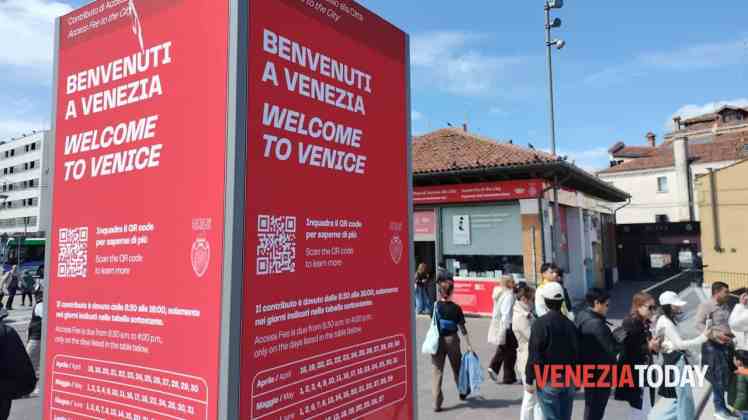
Mayor Venturini has raised the issue of raising the entrance fee several times, but among the parties, only Forza Italia has expressed support. The law on arrival fees and tourist taxes would have to be amended. Questions have been submitted to the mayor in the city council.
By Leonardo Bison
June 27, 2026
In recent weeks, there has been much discussion in local and national media about the proposal by Venice Mayor Simone Venturini to increase the entrance fee to Venice from the current 10 euros (5 for those who book in advance) to approximately 50. The issue has surfaced again because Venturini discussed it with President Sergio Mattarella during his visit to Venice on June 18, and then several other times in the following days. Mattarella cannot contribute to such a reform, but the mayor subsequently explained that he intends to discuss it with the government, although the timing and method are not yet certain.
However, the government could only issue a decree, which would then have to be passed by Parliament, Italy’s legislative body. The rationale behind Venturini’s proposal is simple: if the entrance fee serves as a disincentive, raising its cost would certainly constitute a greater disincentive. Nevertheless, significant technical and political issues must be addressed to make it a reality, starting with obtaining a parliamentary majority to approve that decree, given that Venturini is a citizen and does not have a national party.
The legislative issue: Venice should be “decoupled” from national law
From a purely technical standpoint, there are two issues. The first is that to raise the threshold for the entrance fee to Venice, given the current laws, the tourist tax threshold (€10) would need to be raised in all Italian cities. Or, alternatively, a specific law could be created just for Venice. To put it simply, the entrance fee is currently based on the 2011 law on arrival fees for the smaller islands, but with a maximum amount based on the tourist tax established in 2010 for Rome.
The second is that the entrance fee is, and will remain, free for friends and acquaintances of those who live in Venice. This loophole has already led to thousands of people gaining free entry as acquaintances in the past three years, without being able to verify (due to privacy laws) who the friends or hosts were. Significantly raising the entrance fee could give rise to a system of reselling tickets at a reduced price (along the lines of “I’ll let you in for free, you give me 10 euros”) a practice which at the moment is essentially nonexistent.
Forza Italia’s request to the Government: “The only way to manage daily flows of tourists”
Neither of these two issues, however, seems to be an obstacle to such a reform, if the political will is there. On this front, the municipal majority appears united (while maintaining free admission for Venetians), but no party other than Forza Italia has clearly expressed support for the increase. Even after Giorgia Meloni’s meeting with Mayor Venturini, no one in the government has yet come out in favor of the reform. Councilor Michele Zuin, a member of Forza Italia (which has representatives in parliament), however, has taken a very strong stance: “Forza Italia supports this proposal. The access fee is currently the only real tool available to Ca’ Farsetti to manage daily flows tourists. This is why we are working on a proposal that can make it more effective on days of high influx, with the aim of finding a new balance between the needs of residents, workers, and visitors.” The changes are therefore expected in the coming weeks.
The Democratic Party: “This solution is not very effective, and we don’t have the data.”
Faced with these issues, yesterday the Democratic Party council group submitted a question to the mayor seeking information regarding the proposed increase in the entrance fee. They consider this approach not only wrong but also unrealistic at this stage, as it would deprive a portion of tourists (those who are not residents of Veneto, who have no friends or relatives in Venice, and are not staying at a hotel within the municipal area) of visiting the city. Giulia Albanese, the group leader in the city council, emphasizes that “we need to move beyond the election campaign and enter a phase in which realistic and effective solutions are proposed.” She emphasizes that “we still don’t have the data to assess the city’s actual carrying capacity. The smart control room data had still not been made public, or only in small amounts, and no discussion has been opened in the City Council on this proposal, even though it would have to go through Parliament to be implemented.”
Data is a long-standing issue regarding the entrance fee. This year, the municipality has chosen to distribute only data regarding paying visitors, not those exempt from the fee, but not on a daily basis: out of 46 days of admission fees so far, the data for paying visitors has been released for only five of them, the first weekend of application and then on May 31st.
Source: VeneziaToday
Don’t miss a story! Sign up here to receive news from Venice by email: