
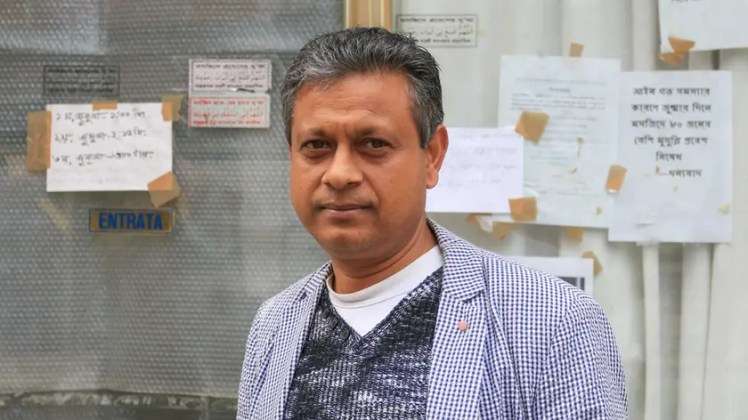
Among the candidates running for city council or Municipal offices are entrepreneurs active in hospitality and tourism, who run CAFs, service centers, money transfer businesses, and construction firms. They are entering the field with the center-left — but also with the center-right UDC.
By Marta Artico
April 30, 2026
The 2026 campaign will go down as the most ethnically and culturally diverse in the city’s history. Fifteen council candidates of Bangladeshi origin are running for office — citizens with migrant backgrounds eager to take part in the city’s political life. They are buzzing with activity, organizing debates, meetings, and dinners.
They print their campaign leaflets in both Italian and Bengali, and have the financial means to run proper campaigns, thanks in part to the networks they move in. Bangladeshi candidates are spread across both the center-left and the center-right, and some were courted by multiple parties for their ability to draw votes — among them Rhitu Miah, a candidate with the Democratic Party (PD), an architect and cultural mediator who speaks at least four languages fluently.
Among the other city council candidates is Kamrul Syed, president of the Venice Bangla School, a man who is active on countless fronts: he is the one who handles the funeral arrangements when a member of the community passes away.
In Marghera, the PD is fielding Sumya Begum — entrepreneur, wedding planner, and the first to speak out against the [anti-mosque, Ed.] posters on the buses. Mhade Abdul, known as Medy — which is also the name of his company — is another very young candidate, born in 1994, a graduate of the Gritti. Following the controversy sparked by campaign flyers written in Bengali, including his own, he took to Facebook to explain the phrase Bismillahir Rahmanir Rahim. “Someone accused me of asking for votes in the name of Allah,” he wrote. “That interpretation is completely wrong. For us Muslims, this phrase means ‘In the name of God, the Merciful, the Compassionate’ — it is a formula of openness and respect that we habitually use before beginning a speech, a project, or an important action. It is a spiritual and cultural custom, not a political tool. Using it does not mean exploiting one’s faith, but rather expressing one’s values and identity with serenity and transparency.”
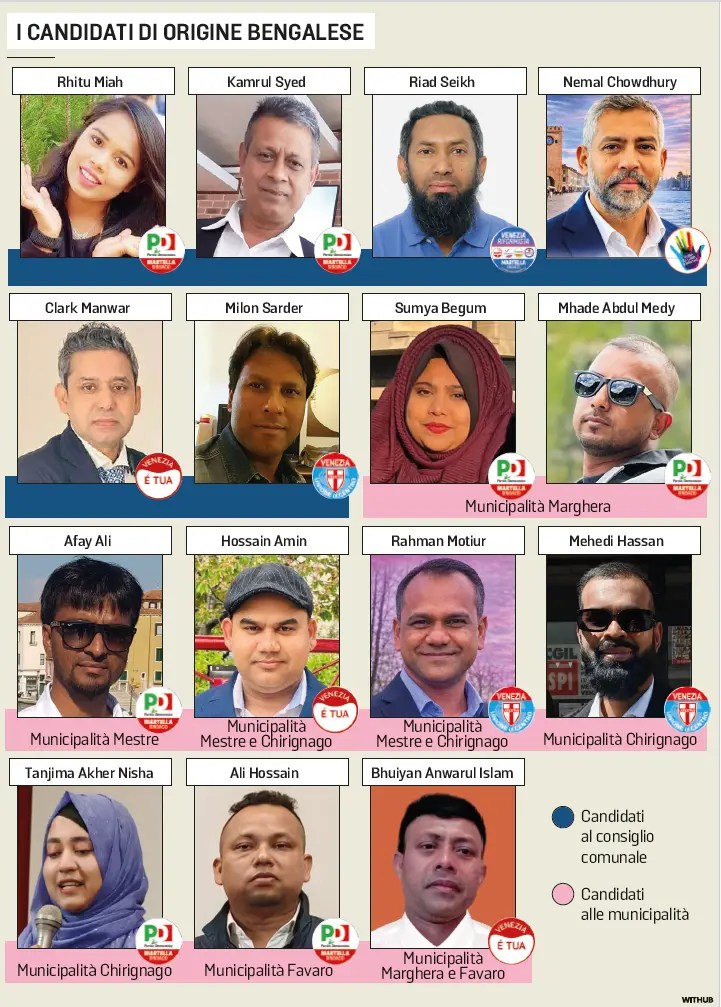
Also running in Mestre is Afay Ali, owner of a money transfer business in the town center and an outgoing Municipal councilor. First-time candidates Tanjima Akher Nisha and Ali Hossain are also on the council ballot.
Venezia Riformista has its own Bangladeshi city council candidate in Riad Seikh, the owner of a minimarket on Via Ca’ Rossa who worked for years at Molino Stucky. And then there is Martini’s Tutta La Città Insieme list, which includes Nemal Chowdhury, a restaurateur and B&B owner.
A sure vote-getter is Clark Manwar, who is running as a candidate with Ugo Bergamo’s Venezia è Tua. He is a tourism and hospitality entrepreneur operating between Mestre and the historic center (San Marco and Rialto), with a focus on hotel management. Manwar stood in the last election too, on the former senator’s civic list, picking up a significant number of votes. He narrowly missed a seat on the city council. The first Bangladeshi student at the Giulio Cesare school, he has been in Italy since 1996.
Running alongside him in the Municipal elections are Hossain Amin and Bhuiyan Anwarul Islam. On the center-right, Paolo Bonafè’s UDC has several Bangladeshi citizens on its list. Milon Sarder, running for city council, works in renovations, commercial venues, and tourist rentals, while Rahman Motiur has run a CAF on Via Piave for years. Mehedi Hassan is connected to the community that gathers to pray on Via Giustizia — young, enterprising, and with a large following.
Source: La Nuova di Venezia e Mestre

Don’t miss a story! Sign up to receive news from Venice in your email!

