
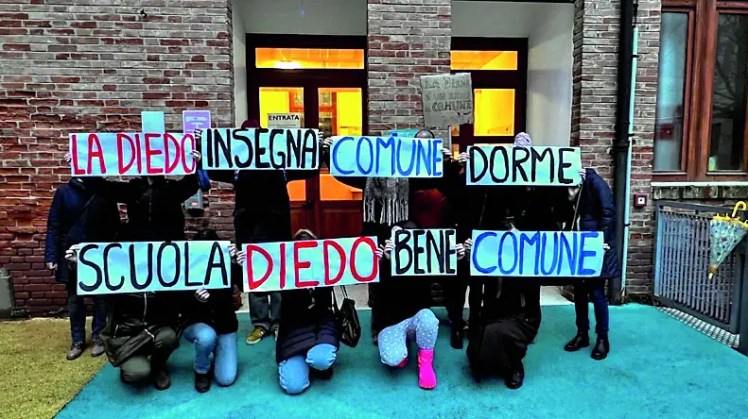
The communication comes in a letter sent to the Sisters of Reparation. The transaction cannot be completed due to an agreement dating back to the late 19th century.
[Ed. Note: this is a follow up to the story published on March 22, 2026 about parents and children protesting this sale of this school]
March 31, 2026
The Patriarch of Venice has sent a notification to the Sisters of Reparation, who have put up for sale the former convent that houses the Diedo Primary School in Cannaregio, that the sale cannot proceed. The transaction should have received approval, but it wasn’t even requested, and in any case, it cannot be completed due to an agreement dating back to the late 19th century: this is what the Patriarch notified the Superior General of the Milanese religious institute.
In the letter, the Patriarchate expresses “true regret” and emphasizes that “to date, the provisions of No. 2.1 of the ‘Guidelines for the Management of Assets in Institutes of Consecrated Life and Societies of Apostolic Life’ issued in 2014 by the Congregation for Institutes of Consecrated Life and Societies of Apostolic Life have not been complied with. These Guidelines reiterate the importance and requirement that there be a ‘dialogue with the local Ordinary […] in the event that Institutes intend to close houses or works or sell real estate’.”
The same letter also recalls the canonical discipline in force in the Church for the sale of assets that, being foundational, constitute the “stable patrimony” of an Institute, as in the case of the Canal-Marovich Convent. The issue raised concerns the Institute of Reparation’s failure to inform the Patriarchate of Venice of its intention to sell assets for which the procedures required by the Holy See have not yet been complied with.
The Patriarchate of Venice then highlighted another issue of even greater significance: the clauses and conditions imposed in the two agreements, one dated May 21, 1876, and the other dated September 20, 1880, signed by the Founders and intended to regulate the union of the Canal-Marovich Institute of Venice and the Nazareth Institute of Milan. These clauses and conditions “oblige the Institute of the Reparation Sisters in perpetuity,” writes the Patriarchate of Venice, “to use the assets of the House and the Venice Fund for the ‘exclusive benefit of Work in Venice’, to the exclusion, therefore, of any other purpose, including that pursued by the House in Milan, and the obligation ‘not to sell, nor mortgage, nor in any way divert said property from Venice’.”
Furthermore, it is also emphasized “that the 1880 agreement inextricably binds the assets of the House and the Canal-Marovich Fund to Venice, placing the Patriarch of Venice pro tempore in a superior position with respect to them, including in the event of extinction, with the resulting rights and duties over the same movable and immovable assets, to the point of assigning to the Patriarch of Venice the task of interpreting and always implementing the Founder’s will”.
The letter, formally sent to Milan, concludes by urging the Sisters of Reparation to declare their firm intention to “fully comply with the wishes of Archbishop Canal, already anticipating that, otherwise, the Patriarchate of Venice will be forced to proceed through the civil and canonical courts to protect the prerogatives that he himself has wished to attribute and reserve in perpetuity to the Patriarch of Venice pro tempore”.
Source: La Nuova di Venezia e Mestre
 Campaign For A Living Venice