
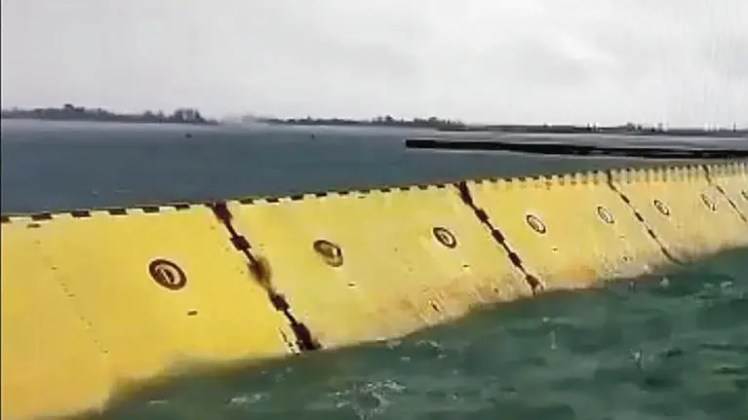
According to Alvise Papa (Tide Center), this is the result of a constant trend: “It is not the result of particularly severe weather events”
By Eugenio Pendolini
7 February 2026
Since the beginning of the year, the tide levels recorded at the platform off Lido have remained above 100 cm for more than 40 hours: this has never happened in the last 20 years, in the same period of the year, for such a long time. It’s enough to talk about a record which, on the one hand, did not involve constant flooding of the city thanks to the intervention of MOSE (raised fifteen times in just nine days), but on the other hand, cannot fail to cause concern, because it is symptomatic of a constantly growing trend: that of the average rise in water levels.
The explanation, moreover, is provided in a straightforward manner by Alvise Papa, head of the Tide Center of the Municipality of Venice: “We are facing a record, yes, but it is not the result of particular weather conditions, but rather of modest disturbances that nevertheless act on a higher average level than that recorded twenty years ago. This leads us to conclude that the statistics for medium-high tides are set to rise despite the presence of the MOSE.”
And it is not just a matter of statistics: the rise in the average level brings with it the need to close the floodgates at the mouths of the port more and more frequently, as well as, at the same time, serious repercussions on the conservation of the city’s buildings. These consequences are set to become increasingly worrying in the future. Here are the data recorded by the Tide Center.
As mentioned, between January and February 6 (inclusive), there were 41 hours during which tide levels remained above 100 cm (12.9 hours in January, 28 in February). In the same period a year ago, the total hours were just over 4: that is, one tenth of the time. Almost thirteen hours in the previous year, sixteen in 2023. To return to levels similar to those of this year, we need to go back to the exceptional tide seasons of 2014 (29.5 hours) and 2015 (34.5 hours).
Another significant figure is that the average level in January 2025 was 36 centimeters, while in 2026 it was 43 centimeters (+7 cm). The numbers skyrocket if we make the same comparison in February: an average of 24 cm in 2025, 68 cm in the first six days of February 2026. In the latter case, however, it is clear that the data is decidedly partial: we must take into account the exceptional events that have occurred in the first six days of the month.
Nevertheless, even looking only at the month of January, the difference is striking. Of course, given the combination of atmospheric factors such as precipitation and wind with the peak of the astronomical tide, each year is unique and it will take time to analyze the wealth of data and draw definitive conclusions. But the evidence is clear and points in the same direction, meaning that, in practice, even ‘modest disturbances’ are enough to raise the average water level.
In the meantime, the city is still grappling with the series of tides that have been affecting Venice since January 28. MOSE has been raised fifteen times so far, in some cases blocking exceptional high levels. This was the case, for example, on the evening of February 4, when the tide at the CNR platform reached 137 centimeters (141 centimeters at the Chioggia dam).
Considering that raising the barriers costs around €200-250,000 (a figure that rises if they remain in operation for several hours), it can be said that from the end of January to the first days of Carneval, the operation of the MOSE system cost almost €4 million and protected the city from considerable disruption and damage.
Source: La Nuova di Venezia e Mestre
 Campaign For A Living Venice