
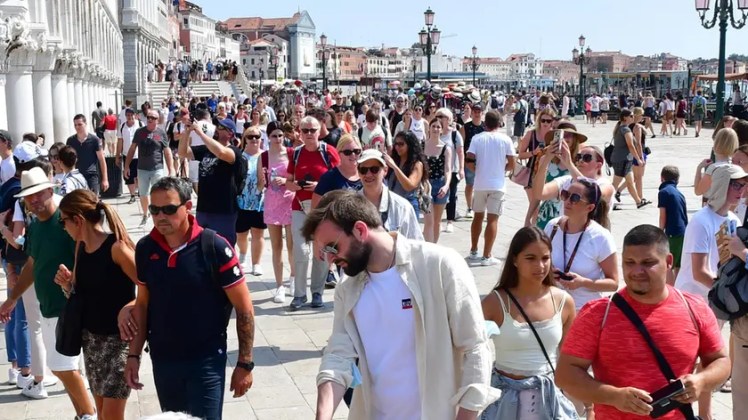
Bed and breakfast owners: “We’ve been forced to lower prices. We’re hoping the Film Festival will help”. Giacomin (ABBAV): “Rentals are down 20-30%. Blame the narrative about the city.”
By Laura Berlinghieri
August 2, 2025
Finally, the inevitable has happened, in a “where” that has long suffered from a paradox, for a place that calls itself a city: tourist beds outnumber the residents. In this postcard Venice, in this holiday-maker-friendly setting, in this papier-mâché scenario, the system has imploded.
“Almost a thousand facilities were forced to close in a year. There were 20 percent fewer guests in Venice, and 30 percent fewer in Mestre compared to 2024,” lists Ondina Giacomin, president of ABBAV, the association of B&B, tourist rental and guest house managers.
This quantifies a phenomenon that economists and sociologists would certainly be able to identify. It explains something that, between the streets and the coastline, some have long noticed. But in a city that is the epitome of tourism, and in a part of the city that has made a point of fighting tourism, the undifferentiated, “tacky” kind, it is a warning flag worth noting.
But prices are continually increasing, because Venice can be sold for any price: rooms that are barely decent yet rented for a fortune. Perhaps all this no longer works, the system seems to have jammed. The city that thought it had no limits has hit a ceiling, and it has slammed into it with force. And those who have converted their homes into bed and breakfasts, taking advantage of this vacation El Dorado, are starting to reckon with empty rooms.
Even in Venice, the city with a once-inexhaustible tourist base, there are too many apartments and rooms for rent. The supply and demand ratio has flipped. Hotels are still holding up – according to Federalberghi occupancy increased by 1.5% in June, and by 0.1% in July for Veneto’s art cities – but the ongoing transformation of the city’s building stock into high-quality, overnight accommodation has reached its saturation point.
“We were forced to lower our prices, especially on weekdays, to make ourselves more attractive.” “We’ve lowered the minimum number of consecutive nights to book from three to two.” “We’re waiting for the Venice Film Festival like manna from heaven.” This is what is increasingly frequently heard around town. Some of the rentals have even closed down, or are considering it.
“My daughter manages three rooms in Tessera, 900 meters from the airport. In April, she called me, asking if she was doing something wrong, given the ‘zero bookings’ she had. All three rooms were empty, simultaneously, while she was preparing three more: it had never happened to her before,” Giacomin admits.
Competing with a 2024 of unrepeatable numbers, 2025 can’t keep up. Nor can it even compare with 2023. It is certainly true that the last two years were impacted by a return to life, post-Covid. But the entire “Venice system” has adapted to this new world: introducing an entrance fee, discussing a limit to the number of daily visitors, and even simply increasing the price of vaporetto tickets. There has been a constant cost increase, which has now reached a limit.
Those who make a living from tourist rentals blame the narratives about Venice: “Photographs of an inaccessible Rialto Bridge, the emphasis on pickpocketing. It’s understandable that tourists turn to Florence and Rome.”
For Venice 2025 began quietly, continuing under the bad star of a subdued Carnival. In April, Easter and the long weekends, with the death of Pope Francis and the Jubilee, many preferred to go to the capital. Then there is the Architecture Biennale, which has never been a major draw. There are also the wars, which have long driven wealthy Russian clients away from Venice (and beyond, of course), and now even Israelis.
“If tourism in Italy has grown by an average of 2.5% this year, and here it has fallen by 20%, other destinations are clearly being favored over Venice,” Giacomin argues. “But the reason is certainly not an excess of facilities – these are not what drives overtourism – but, on the contrary, a lack of tourists.” The city without limits seems to want to be a city again.
Source: La Nuova di Venezia
 Campaign For A Living Venice