
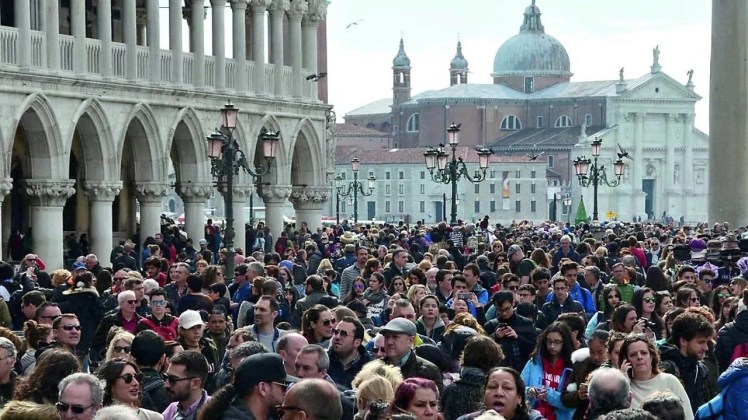
Veneto is confirmed as the top Italian region for tourist reception for 2023. However, when the phenomenon exceeds a certain critical threshold, it risks withering the economic fabric around it
By Giulio Buciuni
Dec 6, 2024
According to the latest ISTAT bulletin on tourist flows in Italy, Veneto has again been confirmed as the top region in the country for tourist visits for 2023. With approximately 72 million tourists hosted in 2023, Veneto has reinforced a trend that has been known for some time and that is being celebrated on several fronts by regional institutions.
Just a few days ago, at the annual meeting of Confindustria Belluno Dolomiti, the governor of Veneto stressed the importance that tourism plays in the contemporary regional economy and expressed his astonishment and disappointment at a series of anti-tourist protests that are spreading from Amsterdam to Barcelona.
For those who deal with economics, tourism is a double-edged sword. Certainly, it can help generate employment and contribute to the economy of places that attract tourist flows, generating an induced effect that is often not limited to mere hospitality but also includes restaurants and the agri-food chain.
However, when tourism exceeds a certain critical threshold, that is, when it becomes a prevalent or dominant economic activity within a national, regional or urban context, it risks withering the economic fabric surrounding it.
In fact, on the one hand tourism is notoriously considered a sector with little innovation, where extractive economic activities often prevail; on the other hand, tourism is an economic sector that generates less added value per employee than more innovative activities such as industry and manufacturing.
The ISTAT data available to us on the trend of hourly wages in Italy clearly certify this phenomenon. Taking the evolution of wages from 2007 to 2023 as a reference, it is possible to observe that the tourism sector has recorded an increase in wages equal to 25%.
This may seem encouraging, but it actually hides a particularly worrying scenario. In the same period of time, in fact, average wages in the manufacturing sector grew by 45% and, above all, a cumulative inflation rate of 37% was recorded.
In short, after adjusting for inflation, wages in the tourism sector have contracted by about ten percentage points, impacting the purchasing power of workers employed in this economic sector and the ability of companies to attract qualified personnel.
Tourism is therefore not inherently an economic activity capable of generating innovation, much less guaranteeing competitive salaries in the long term. In an economic context such as that of North East Italy, which today is grappling with certified problems in attracting qualified human resources and with an innovation model that is still unable to express an ecosystem of international importance, tourism is certainly not the industry that can lead the way for the future of the regional economy.
Yet, what appears to be a common-sense consideration, supported by easy-to-read public data, currently clashes with a mainstream narrative that sees tourism as one of the cornerstones of the North-Eastern Italy’s economic model.
Source: Il Mattino di Padova
 Campaign For A Living Venice