
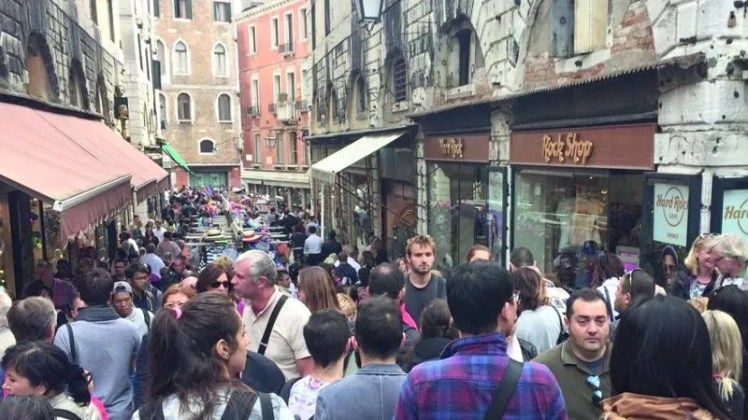
Galietti (CLIA): “We are working towards de-seasonalizing the flows of arrivals. Professor Preiti: “All the indicators say this is overtourism, a stop is needed”
By Giulio DePolo
October 6, 2024
Overtourism in Venice – the historic city of Venice has now exceeded the point of no return in terms of the number of daily tourists, just for those staying in hotels and short-term rentals: 5,048 per square kilometer.
On a surface of 7.8 km2, there are a total of 14,373,012 tourists, that is 39,378 per day, with an index of 7.8 points out of 10, even exceeding the limit of 7.5. This confirmation comes from the data processed by Sociometrica in the report on overtourism in Veneto produced for Federalberghi in 2023 by Professor Antonio Preiti, professor of Destination Management at the University of Florence.
“Since then, the situation has certainly worsened,” the professor explains, “and significant interventions are needed immediately to manage a phenomenon that is destined to increase year after year.”
Looking at the number of residents, the study indicates that the number of tourists physically present every day of the year in the historic city is equal to or exceeds the number of residents. This is a clear indicator of overcrowding that shows no signs of decreasing.
“All the indicators point to a situation of clear overtourism” is Professor Preiti’s analysis, “and the problem in Venice is the most sensational. It is therefore necessary to intervene, but it is not easy, because having a number of tourists equal to or greater than the number of residents present in the city every day of the year makes the solutions difficult, and they must be addressed comprehensively. It would be too easy to impose a selection policy based on the tourists’ financial resources, but Venice is a heritage of humanity, that is, it belongs to everyone, and everyone must have the opportunity to visit it. So, there are no easy solutions, but important decisions are needed regarding the management of the flows”.
The report then explains another aspect of the issue: the study states that “the saturation of more than three quarters of the overall hospitality potential of a destination” can trigger “negative mechanisms both on the demand side, because tourists might not find great satisfaction in a “crowded” location, and on the supply side, because residents can have the feeling that the sacrifices to their quality of life outweigh the advantages brought by tourism”.
The very recent report, The State of Tourism and Hospitality 2024, produced by McKinsey & Company and presented a few days ago in Rome by CLIA, the international association of cruise companies that has reached agreements for the management of flows in Dubrovnik, Croatia, Corfu and Crete in Greece and Kator in Montenegro, also addresses the problem of overtourism.
“We are working with local authorities with the aim of de-seasonalizing arrivals,” explains Francesco Galietti, Director of CLIA Italia. “In some cases, such as Venice, cruise ship disembarkations are less than a third of those of 2019, while overall incoming flows are increasing, causing situations of tourist overcrowding which are not our fault.”
The study predicts that by the end of 2024global tourism should reach a turnover of 8.6 billion dollars (9% of global GDP) with a constant increase of 6%, and therefore one of the objectives to overcome the phenomenon of overtourism is to de-seasonalize.
“Our data confirms overtourism in Venice,” explains Francesca Benati, CEO of Amadeus, the world’s leading booking registration company, “but they also demonstrate that bookings are made well in advance, especially by tourists coming from the USA.”
In January, February and April 2024, the flow of bookings to Venice exceeded that of 2023, then decreased in May, June and July.
“Now bookings for Venice are spread out over the entire 12 months, but often happen well in advance, especially for flights from the USA, both for direct connections with Marco Polo airport, which reports constantly growing traffic, and for those with a stopover in a European city”.
Source: La Nuova di Venezia e Mestre
 Campaign For A Living Venice