
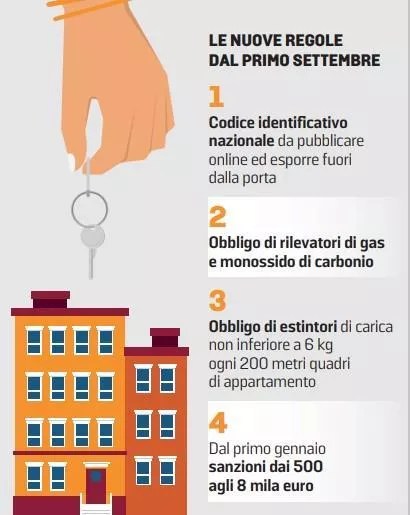
New rules come into force on September 1st: a code, fire extinguishers and carbon monoxide detectors are required. Fines will range from 500 to 8 thousand euros
By George Barbieri
August 30, 2024
A national identification code to be published online and displayed outside the door of the property. Inside the apartment, mandatory gas and carbon monoxide detectors and fire extinguishers with a load of not less than six kilograms for every 200 square meters of surface.
And for those who do not comply, there are fines that range from 500 to 8,000 euros. The reform promoted by the Meloni government will come into force on September 1st, changing the rules regarding so-called short-term rentals in the Northeast, which have been controversial in recent months because they are accused of favoring strong increases in house prices and the depopulation of historic neighborhoods in cities such as Venice and Florence.
Between Veneto and Friuli Venezia Giulia, it is estimated that there are over 70,000 properties registered and currently advertised as short-term rentals on online platforms (above all Booking.com and Airbnb). These will have to equip themselves with a national identification code (CIN) which, according to the government, will not only represent a mark of quality for tourists but also of full compliance with the law, particularly regarding taxes.
Countering overtourism
It must be said that, despite pressure from local authorities in particular, this is a ‘soft’ regulation which is still far from the measures adopted by cities like New York, which only allows short-term rentals of apartments where the hosts, i.e. the owners or tenants, live in person and are actually present, or Barcelona, where the socialist mayor Jaume Collboni has announced that licenses for vacation rentals will no longer be renewed after 2029.
In Italy, the former mayor of Florence, Dario Nardella, tried to pass a similar measure with an ordinance that prohibited the creation of new Airbnb’s in the UNESCO area of the historic center that corresponds to the ancient circle of the fourteenth-century walls. However, the measure was immediately rejected by the TAR.
The identification code
According to data provided by the Ministry of Tourism, in Veneto only 13.7% of the over 57,000 short-term rental properties in the region have registered (Verona being in the lead with 20%, Venice further behind with 11.4%), while in Friuli Venezia Giulia, in part due to the fact that the Region was among the last to enter the pilot phase of the Database of Accommodation Facilities, the numbers are still very low: only 0.65% of the over 14,000 properties are registered.
However, there are still a couple of months to comply, as the deadline extends 60 days from the publication of the new regulation in the Official Journal on September 1st.
In fact, the entire system of sanctions related to the Identification Code will come into force in 2025 and after that deadline, anyone who advertises their property without a code will be punishable with a fine of up to 5,000 euros. Not only that: anyone who rents without a CIN risks a fine of up to 8,000 euros. The heaviest fine could even come from the market, as online tourism platforms (the so-called OTAs, online travel agencies) are aligning themselves with the new rules and have in recent weeks reassured the ministry that with the activation of the CIN they will no longer advertise properties without a code.
Safety devices
At the same time, and this will be the real novelty, there is a new obligation to equip properties with gas detection devices as well as portable fire extinguishers. Although in this case, the penalty for any shortcomings (up to six thousand euros) will only apply to those who are running tourism-related businesses.
“A great team effort has been achieved, for which I thank the government, the Regions and the ministry staff,” explained Daniela Santanché, Minister of Tourism. “This reform, the importance of which no previous executive understood, in addition to representing an important resource for the coordination and management of data relating to accommodation facilities present on the national territory, is designed to regulate and not criminalize short-term rentals. I am not in favor of absolute bans, because in many Italian areas where hotels are scarce they are essential for welcoming tourists and helping with the decongestion of the flows of people.”
The numbers
According to Eurostat data for 2023, Italy was by far the European country with the most visits booked by foreign tourists through “collaborative economy” platforms (especially Airbnb and booking). Spain followed, where recent protests against tourists using water pistols have caused a lot of discussion, and France, where the situation has worsened significantly in recent months in Paris, especially in relation to the Olympics.
Source: La Nuova di Venezia e Mestre
 Campaign For A Living Venice