
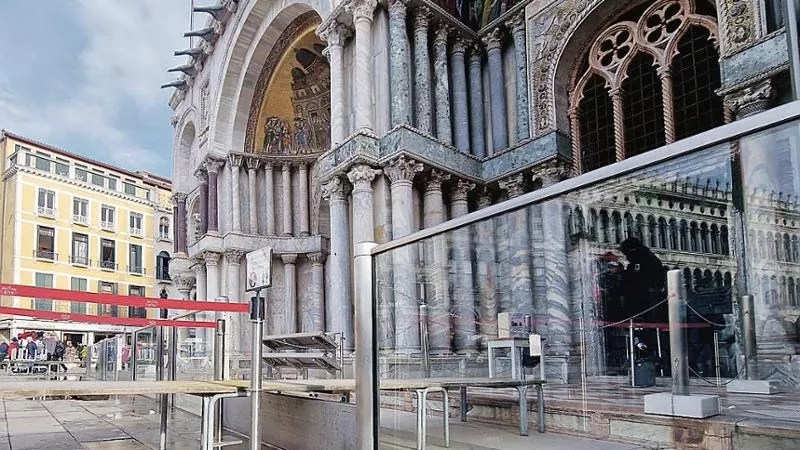
This is what the Venice Prosecutor’s Office decided to avoid further problems after the failure of the barriers. But there is controversy over the maintenance of the glass installation
By Eugenio Pendolini
January 9, 2024
The technical mix-up that caused part of the Basilica to flood on Saturday January 6 due to the failure to position a floodgate has already had an effect which is clearly visible.
Starting from Monday January 8, to enter the sacred building, the symbol of Venice, you will need to cross the walkways usually used for acqua alta, even in the absence of acqua alta – as in fact happened from late yesterday morning and throughout the afternoon. Whether this is a paradox, or a simple precautionary measure depends on your point of view.
What is certain is that this new configuration for access to the Basilica will remain in place. But it is impossible to say for how long at the moment.
It will take time before arriving at the new protocol that regulates – once and for all – the management and maintenance of the glass barriers that protect the Basilica. A piece of paper, in short, that prevents Saturday’s mess – which was caused by a failure to check the tide, which coincided with the shift change of the teams from the company that has been responsible for the closure up to now – from happening again.
The meeting organized two days ago by Superintendent Tommaso Colabufo will be repeated in the next few days. In addition to the Rossi Renzo Costruzioni company, which carried out the work and which has closed the barriers up to now, the Municipality and the Procuratoria di San Marco will also be present at the table.
The Procuratoria
However, after Saturday’s episode, the climate is anything but serene. The Procuratoria has pointed the finger at the lack of dialogue between the State and the Municipality for the “management of a public work in a public square”.
The hope is that now a positive conclusion to the matter will finally be reached.
On the other hand, to date the public works offices of the Municipality of Venice have not received any summons for the next few days, nor in the past had there ever been any talk of the Municipality’s involvement in the maintenance and monitoring works of the installation – which, we should remember, has yet to be tested. The barrier project never even passed through the Municipality.
The issue of barrier management was also evident from the presence of metal fences covering the barriers themselves.
These disappeared in August, and they were used to protect the barriers from possible impacts, cracks and dirt while waiting to understand who will be responsible for managing their maintenance. As if that wasn’t enough, at the end of the year the companies that carried out the work, including Kostruttiva, reported missed payments of around one million euros (out of the total cost of the work) by the Board of Public Works and the Consortium New Venice. The cause of the delay is that the Superintendency, the Magistrato alle Acque, is short of cash, all of which will be used to complete MoSE.
Walkways to enter
In short, what can be done? With the exception of last Saturday, the barriers have so far kept the Basilica dry, waiting for the entire St. Mark’s area to be protected from tides of up to 110 centimeters. For the moment, however, we will have to get used to the idea of the walkways positioned at the entrances to the Basilica.
And in fact, already on Monday January 8 there was a lot of amazement in the long line of tourists who crowded the Square to enter the Basilica.
It required some extra physical effort for older visitors, forced to “climb” over the wooden walkways. What about people with disabilities? Someone, with a wheelchair in tow, approached to ask the service workers how to climb over not one but two barriers (including the steel gate). Within a few minutes, everything was resolved. “The physically disabled enter, even when there is no acqua alta, from the passage next to the patriarchal palace, and from there through the Nicopeia door”, explains Professor Mario Piana, the Proto of San Marco.
-Source: La Nuova di Venezia e Mestre
 Campaign For A Living Venice