
The entry fee is also included in the document, which is scheduled to be approved in January. Italia Nostra and the opposition have written to the Municipality to ask that the discussion be made public and that there be more involvement from the citizens, but have received no response
By P. Baron
December 14, 2023
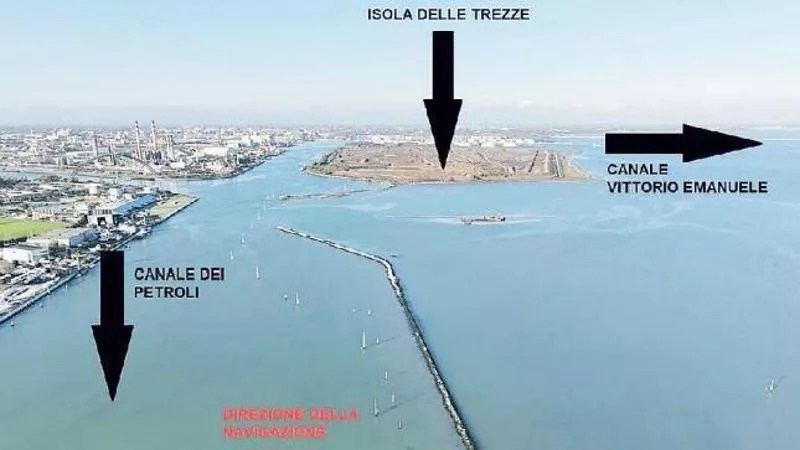
Excavation of the Vittorio Emanuele canal and docking large cruise ships in Porto Marghera. These are some of the critical points that have been inserted into the UNESCO Management Plan 2024/2030 “Venice and its lagoon”, a document that should have been discussed and finalized by the Municipality today. However, that meeting has been postponed to January.
The critical problem is the fact that this final draft included the project to excavate the Vittorio Emanuele canal, even though UNESCO has called for the ships to remain outside the lagoon “in a structural and definitive manner”.
It’s an issue that could create friction. In fact, recently Italia Nostra and the opposition have written to the Municipality to ask that the discussion be made public and that there be more involvement from the citizens, as foreseen by the Plan itself.
The Municipality had not responded on this point. The dossier, composed of a main body of 200 pages and respective appendixes, currently presents several chapters regarding the main themes of the city, starting precisely with the excavation of the Vittorio Emanuele canal. In the chapter “New docks for large cruise ships at Porto Marghera and Chioggia” we read that “we are evaluating an intervention which envisages bringing medium-sized cruise ships back to Marittima Station in the historic city through the excavation of the Vittorio Emanuele III canal, parallel to the Ponte della Libertà.”
The update of the UNESCO Management Plan (which stopped in 2018) is no small matter. It is one of the conditions set at the UNESCO World Heritage event held in Saudi Arabia last September, after deciding not to include Venice in the list of At-Risk sites. The UNESCO World Heritage site is coordinated locally by a management committee made up of the Municipalities of the Lagoon, the regional MIC, the Superintendency, the regional Museums management, the Port, the Diocese and the Services Administration. These bodies have the task of drawing up the new dossier, discussing it and approving it.
In the Environment and Climate chapter, UNESCO has set the objective of “adopting mitigation and adaptation measures to climate change to be integrated into planning tools”.
As a response, the Municipality, as the coordinator, focuses on the protection of San Marco island, the completion and monitoring of Mose, an action plan for sustainable energy and green mobility, the Hydrogen Valley at Porto Marghera, and the Venice Foundation – World Capital of Sustainability. The Atlas of Lagoon Foods is also included on the protection side. In the part about tourism management, however, they write in the document that the “entry fee and reservation system could represent a key action for the (tourism) system, which triggers virtuous dynamics of use for places that are most subject to visits”.
Where UNESCO asks for intervention on accommodation facilities, the actions proposed in the document are related to urban gardens with social value.
UNESCO, however, underlines a variety of critical problems that need to be addressed: polluted or at-risk sites as a consequence of industrial activities, lack of communication from entities responsible for citizens, depopulation and an aging citizenry, minimal awareness of citizens of the pre-established commitments and the abandonment of neighborhood activities. In the final summary, as mentioned, UNESCO recognizes the positive effect of MOSE and hopes for its completion, while reiterating that ships must stay out of the lagoon. A chapter is also dedicated to the port of Chioggia, in particular to its dismantling and relocation outside the boundaries of the UNESCO site.
In general, the importance of collective participation is reiterated, as has been requested by Italia Nostra and the opposition councilors, who would like decisions to be shared in the city council. Last September, twenty countries voted to keep Venice within the UNESCO site, going against the request of ICOMOS, a UNESCO advisory body, which had raised a cry of alarm about the city and recommended it be placed on the list of At-Risk World Heritage Sites.
Source: La Nuova di Venezia e Mestre
 Campaign For A Living Venice