
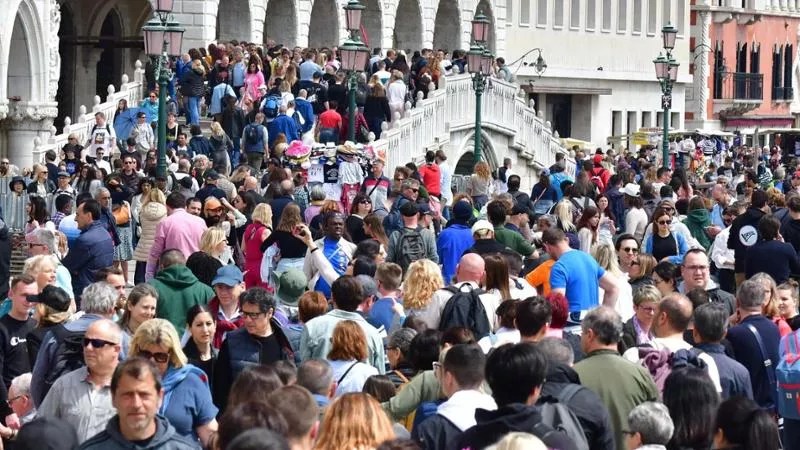
“Overtourism”. The American publishing house most followed by “quality” tourists puts the Serenissima in first place among the travel destinations to avoid in 2024. “The entrance fee will not work”
By Eugenio Pendolini
December 1, 2023
A travel guide publisher rejecting and advising against going to some of the most visited tourist destinations in the world? Even though it seems like a contradiction, this is what Fodor’s, founded in 1949 and based in California, has done.
And yes, Venice is at the top of the “blacklist” in the category of “excessive tourism” (along with Athens, Mount Fuji and other locations). “We hope this list encourages readers to find new ways to interact with some of the world’s most iconic attractions, rather than avoid them altogether”, begin the editors of Fodor’s. “Despite all its negative aspects, tourism is also extremely positive: it builds bridges between cultures, creates awareness, improves economies and connects us to the earth we all live on. But only if done with care.” Which, evidently, is not what is happening in the lagoon.
The reason immediately provided by Fodor’s experts leaves little room for the imagination: “Venice has been plagued by overtourism for years and continues to be unable to solve its problems. Their new method of curbing visitors, a modest entrance fee, is unlikely to work as a disincentive for tourists.”
To tell the truth, this is not the first time that the city has been included in Fodor’s “No List”. In 2018, cruise ships were targeted as the reason. In 2022 it was the ratio of annual number of tourists per resident in the city: 370 to 1.
“Despite the Municipality of Venice’s actions, things have not improved”, those at Fodor’s say. Here in Venice, the Municipality’s actions are the big news planned for next year. According to the administration, the 29-day test of the entry fee (a reservation and a 5 euro ticket), will help them begin to understand how to best manage tourist flows and possibly discourage those who want to come on the weekends that are typically busier.
But day-visitors are not the only problem, explain the authors of the American tourist guide, who cite the statements of Susan Steer from the non-profit association, the Venice in Peril Fund: “In recent years, thousands of new beds have been built in nearby Mestre, and this has gentrified a very run-down area, but at the same time these are budget hotels, whose guests are putting immense pressure on the local transportation networks to and from Venice.”
Finally, the third and fourth element contained in the analysis, motorboat waves and the collapse in the number of residents, whose effects are felt respectively in the need for continuous maintenance work and in the disappearance of the social fabric.
Overall, it is not a pretty picture. And it is further tinged with the risk – eventually avoided – of the feared downgrade by UNESCO, whose technical commission had proposed including Venice among the at-risk World Heritage Sites. “While it may have been a temporary relief to maintain its (UNESCO World Heritage) status,” Fodor’s concludes, “no one should view Venice’s continued deterioration as a victory.”
Source: La Nuova di Venezia e Mestre
 Campaign For A Living Venice
This article does not ‘FAIL’ Venice. It is benevolent to the beloved city and its pitiable citizens of the historic centre. As long as the city council does actively sharpen more and more the problems of overtourism lovers of Venice can not help but stay away. STAY AWAY!
LikeLiked by 1 person
Foders has tiptoed into the tourism waters by citing the incredible mismanagement of Venice but their stance is less than courageous.
“We hope this list encourages readers to find new ways to interact with some of the world’s most iconic attractions, rather than avoid them altogether” and what might these suggestions be?
Why not avoid Venice all together if hoards of tourists are causing deterioration?
At what point is every tourist who arrives in Venice complicit in her destruction?
LikeLike