
A Phenomenology of Short-term Tourist Rentals.
What are we talking about when we call for their regulation?
For years OCIO (Civic Observatory on housing and residential populations) has argued for the need to regulate short-term tourist rentals to protect residential populations and combat the lack of sustainably priced housing on the residential market. Despite several studies demonstrating a correlation between the spread of short-term rentals and an increase in the cost of long-term rentals, proposals to regulate the phenomenon are often met with protests from sector operators who argue that short-term tourist rentals represent a source support for residential living. Therefore, the argument goes, families and residents are harmed by limiting them. But is this really so?
To get a deeper understanding of the issue we investigated the different types of short-term tourist rentals in the historic city of Venice. We remind you that the Tourist Rental is a short-term rental contract, less than 30 days, aimed at tourists, which involves properties intended for residential use and does not require any provision of ancillary services. Despite a great debate on the topic, at the moment there is no law in Italy that regulates this phenomenon (as is done in almost all European countries and cities).
During the course of the research, we discovered that due to this regulatory gap:
- hotels have increased their accommodation capacity by managing apartments under tourist rental arrangements;
- entire residential buildings have in fact been transformed into hotel accommodation facilities, without however being transformed from an urban planning or fiscal perspective;
- tourist rentals are being used by companies associated with multinationals, banks and groups of owners.
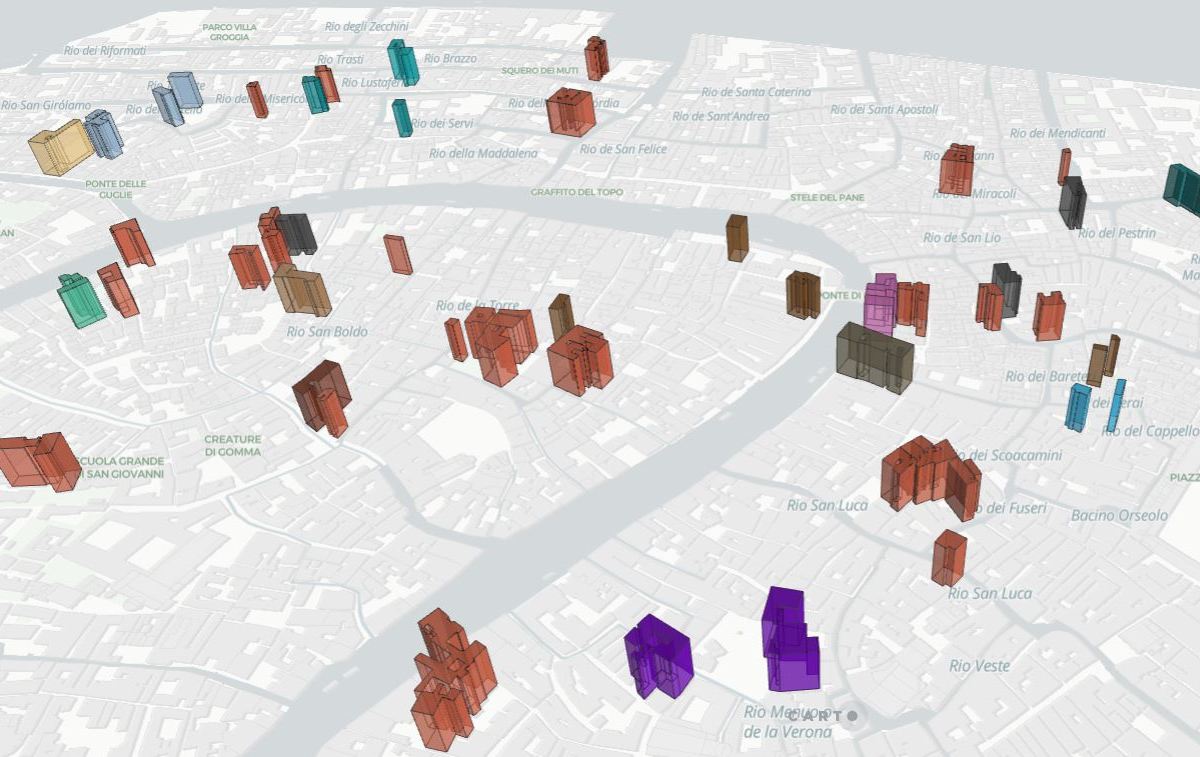
Explore the interactive map, or learn more in the sections below dedicated to each point.
THE NETWORK
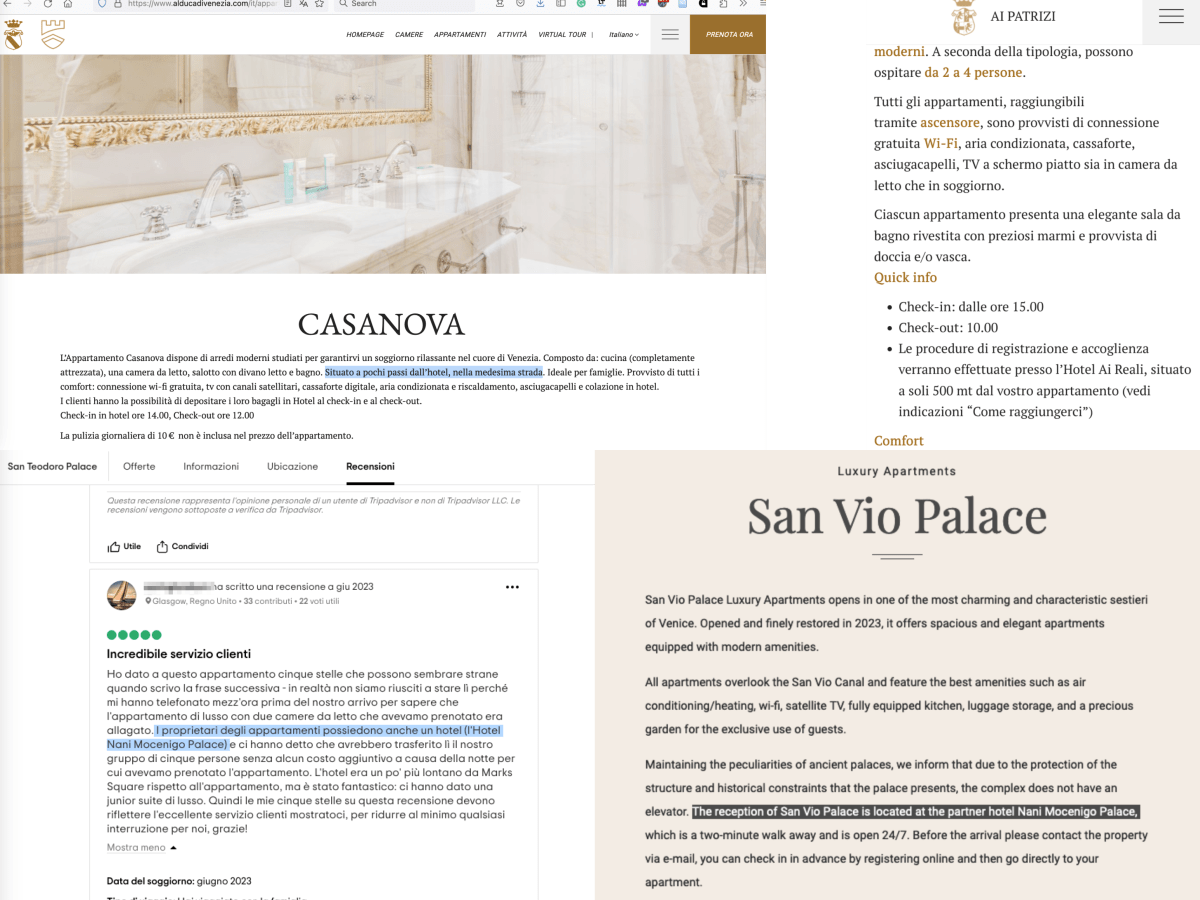
It is 2007. Ca’ Foscari University sold the historic Palazzo Nani Mocenigo (in Fondamenta San Trovaso), home of the Philosophy Department, to Fox Srl. The rector of the University specified that there are no characteristics of the sale to allow use of the building as a hospitality business. A few years pass, and it is the Superintendent’s Office that ends up sanctioning the zoning change: Palazzo Nani Mocenigo becomes a hotel. The new accommodation facility, judging from the web sites and the company that manages it, is connected to other Venetian hotels: Hotel ai Reali (in the former headquarters of the TAR in Campo della Fava), Hotel ai Cavalieri (Palazzo Papadopoli Friedenberg), and Hotel al Duca (near Campo San Giacomo de l’Orio). Two non-hotel structures also belong to the group: Al Bailo (Palazzina Buttaro, a public asset sold in 2007 and purchased by a company that is part of the HPH group) and Al Redentore (on the island of Giudecca). We mention the HPH group because this group also includes 12 “Ai Patrizi” apartments (50 beds), 13 apartments at the “San Teodoro Palace” (50 beds), 6 apartments in the “San Vio Palace” (33 beds) and the “Suite Casanova” (4 beds), all of which are subject to the tourist rental regime. These apartments are actually managed as an extension of the group’s hotels, to the point that guests are advised to go to the reception of the Hotel Reali or the Hotel Nani Mocenigo for check-in – as stated on the website of the two structures and as complained about by many tourists in the reviews provided on the Booking.com portal. The “Suite Casanova”, despite being a tourist location belonging to a separate building, is advertised on the website as part of the Hotel al Duca.
THE PSEUDO-RENTALS
Although the case of the 31 rentals mentioned above is quite striking, the practice of increasing accommodation capacity through tourist rentals is widespread among Venetian hoteliers. In addition to the 18 rooms the Venice Certosa Hotel (Certosa island) advertises on its website, it also lists “5 semi-detached annexes, the crew houses, which allow for a different, more immersive approach to the vacation, enjoying a fantastic panorama of the lagoon”. These crew houses are in fact tourist rentals, for a total of 16 beds (i.e. 39% of the hotel’s total accommodation capacity). Ego Boutique (Palazzo Bembo, a few steps from Rialto) is a hotel with an associated residence managed with tourist rentals, for a total of 34 beds, of which 13 are TR.
It is not illegal for a hotel to rent rooms as tourist rentals, but, especially for rentals opened after 2017, we believe it is still a stretch. In fact, in 2017 the Municipality of Venice introduced a rule that slows down the automatic transformation of properties into accommodation facilities, as well as the expansion of existing structures through a resolution that delegates case-by-case evaluations to the City Council. Unless approved, “new establishments or expansions of hotel and complementary accommodation activities” are therefore not permitted. However, some hotels can expand and increase their accommodation capacity independently by opening tourist rentals, without the need to request a zoning change for the property, and therefore without running afoul of the resolution.
THE PSEUDO-HOTELS
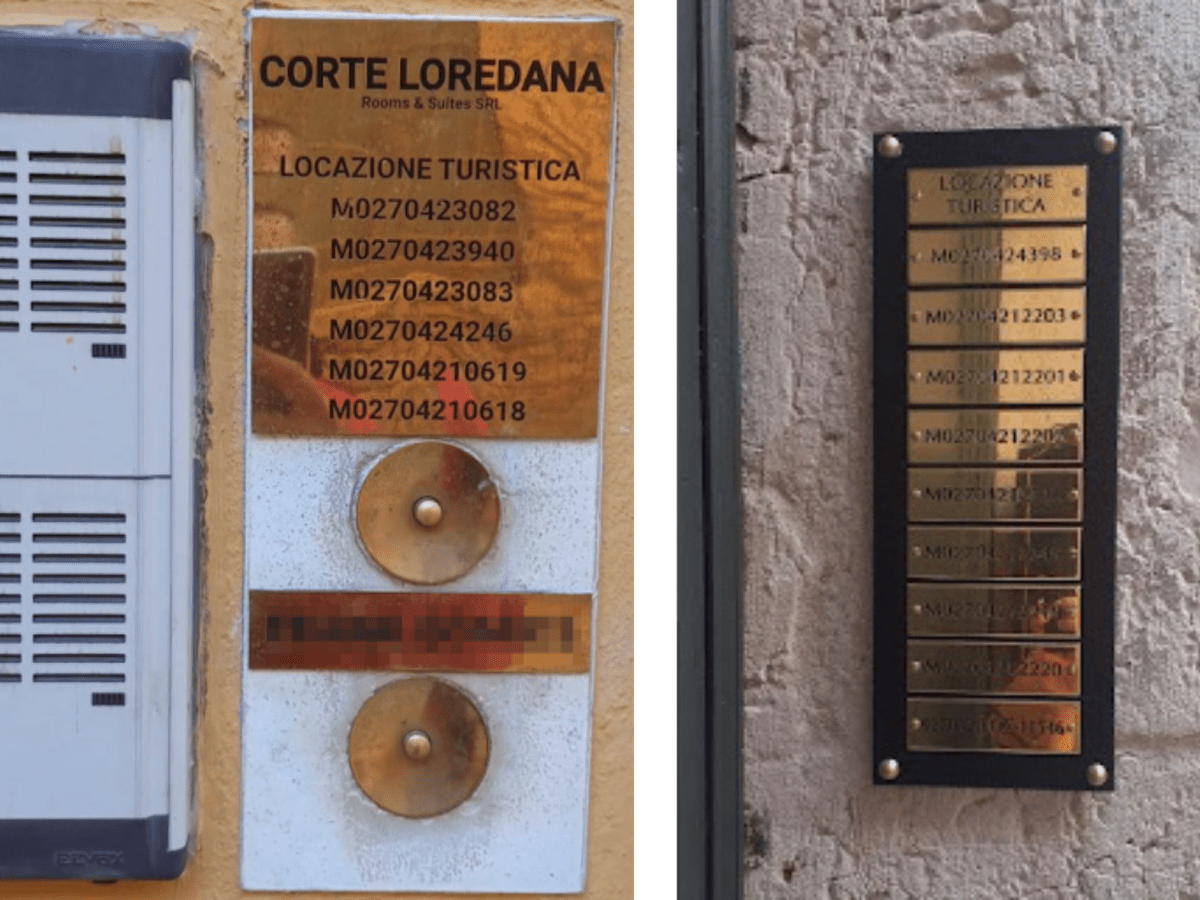
While the previous category involves hotels expanding in different parts of the city by using tourist rentals, here we are talking about something of the opposite phenomenon: tourist rentals that are concentrated in a single building or in several surrounding buildings which in reality function as a hotel, although not being formally (or fiscally) hotel accommodation businesses. Even in this case there is nothing illegal in form, although in substance a transformation of the residential nature of entire properties takes place here as well. It is difficult to know exactly how many there are: the Tax Office reports 3,948 different street numbers in the Historic Center of Venice with at least one tourist location. Of these, 1,070 have at least two and 84 have more than five. Finding out the owner or manager of each is impossible, as this data is not publicly disclosed. We must also keep in mind that:
- the owner of an entire building can register each tourist rental with different company names at the Tax Office – for example, even if their management is entrusted to different property managers;
- the owner of an entire building can rent out all his apartments while registering only one license. Unlike the first point, this is not legal, but it does happen;
- an entire building can have apartments with multiple owners, but all rented to a single entity who then sublets them (or manages them) as tourist rentals, as part of a single structure.
In this section, and in the linked map, we therefore offer several cases in which it seems highly probable that multiple tourist locations are managed as if they were rooms in a single pseudo-hotel structure.
Thus we have Palazzo Morosini degli Spezieri (in San Polo, near the Chiesa dei Frari) with its 9 apartments, of which 6 are registered as tourist rentals, or Palazzo Venere (Calle della Laca, in San Polo) with 8 tourist rental apartments for a total of 20 beds, or Corte Loredana (in Cannaregio, near Rio della Misericordia) which manages as many as 49 beds for tourist rentals, according to data from the GeoIDS portal. There are also cases like Palazzo Loredan dell’Ambasciatore, which houses 6 apartments – all tourist rentals. According to Wikipedia, the Palazzo is owned by the Gaggia family, so it is therefore not surprising to see all 6 apartments managed by Views on Venice, run by Filippo Gaggia. Finally, Palazzo Badoer-Gritti in Campo della Bragora hosts a hotel (Hotel La Residenza with 25 beds), a complementary accommodation facility (6 beds)… but also 8 tourist rentals in the Doge Morosini Palace (39 beds).
These buildings, like the others identified on the map, have a single Booking.com advertisement or a single dedicated website for all the apartments, as if they were part of a single structure. While the previous cases concern historic buildings, dynamics of this kind do not spare even the most modern ones. Behind the Santa Lucia station there is the Centrale Mazzoni building, “a masterpiece of rationalist architecture from the 1930s that GruppoFonArchitetti has rescued from decay and consigned to history”, with the aim of “returning it to the community as new and exclusive residential space”, we read in an article dedicated to the project. At the Centrale’s residential number, Cannaregio 96T, there are 6 tourist rentals registered: we have not been able to reconstruct their ownership, but some appear to be managed by a single entity (Appartamenti Centrale Mazzoni).
THE BANK
Bemate.srl is a Spanish company of the Room Mate group to which Sidief, the BankItalia real estate company, has rented its 12 apartments in Calle degli Stagneri (not far from Campo San Bartolomeo). It was 2019 when the entire building underwent major renovations. Some of the tenants have already left and others have contracts that are expiring or expired. Sidief guarantees the maintenance of the “zoning of the building for residential use”. In fact, no zoning changes are needed: all the apartments are already short-term tourist rentals.
THE MULTINATIONAL
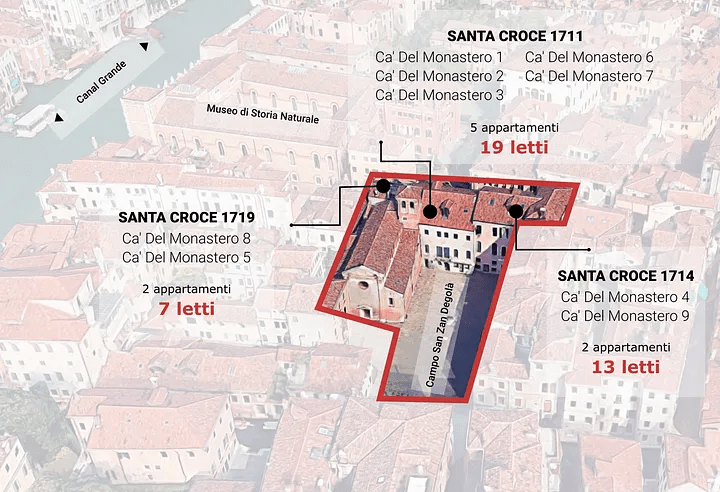
A few steps from the water traffic of the Grand Canal, halfway between the human comings and goings of the Santa Lucia Station and the river of tourists that runs through Rialto, and a few meters from the lively Campo San Giacomo dell’Orio, there is a small campo with a curious name: it is Campo San Zan Degolà, which translates into Campo San Giovanni Decollato or Beheaded. Immobildex Venezia has purchased entire buildings around this campo to make them tourist rentals: 9 in total, for a total of 39 beds. To put things in perspective, by contrast, there are only 2 residents left in these buildings. Immobildex Venezia, despite its name, is based in Rome, and is linked to the heirs of the founder of Sigma-Tau Industrie Farmaceutiche, now merged into Alfasigmatra, one of the main Italian groups in the pharmaceutical sector – the makers of Neoborocillina (an NSAIA pain reliever), that is.
AND THE RESIDENTS?
Obviously with this mapping we are not stating that there are not people who rent their home (or second home) more or less occasionally, for a variety of reasons which, among many, also allow them to remain and live in Venice. In fact, the regulatory proposal put forward by ATA, of which OCIO is one of the promoters, takes this possibility into account. But from the mapping we are doing it is clear that:
- the growth and pervasiveness of the phenomenon is due to a specific and unjustifiable regulatory void in our country;
- only through precise regulation can we prevent short-term rentals from being used by multinationals, industrial groups, owners of entire buildings, and foreign companies… to extract the most important resource for the city and its inhabitants from the territory: housing.
METHODOLOGY
To document the information necessary to write the article, open-source intelligence (OSINT) methods were used, combined with open data and chamber of commerce and land registry searches.
OPEN DATA
All information on the status of the structures (tourist rentals, hotels, extra-hotel structures) comes from the municipal portal GeoIDS, which in turn contains the information declared by each structure at the Tax Office. If there are any discrepancies between what we have described and reality, they are therefore most likely to be found in inaccuracies present in the original data source or in the declarations sent to the Tax Office. However, if there is an error on our part, please send us an email and we will check it as soon as possible.
For the association between an address and a building, the Technical Map of the Topographical Geodatabase was used (specifically the layers of the Built Chart and the ToponimiNumeriCivici Chart). This association was made manually: if we got a building wrong, let us know!
LAND REGISTRY AND CHAMBER INSURANCE
To verify the actual ownership of the main properties mentioned in this research, cadastral surveys were carried out. To verify the actual links between companies, searches were carried out at the Business Register, with which we found the recurrence of the same names among the partners, board of directors and/or other positions of these companies.
TRANSPARENCY
The data on all the structures monitored and mentioned in this article can be found here, and can be reused under CC-BY license [Processed by OCIO Venezia on data from the GeoIDS Portal of the Municipality of Venice]. The data is up to date as of 11/11/2023 and therefore does not reflect any subsequent changes: anyone who cites them at a later date is therefore invited to check the current situation on the GeoIDS portal.
Although this is information found through public sources, for privacy reasons we have removed the column used to document the owners and managers of each property from the data file. For the same reason, we do not publish screenshots of reviews, cadastral and chamber of commerce records, or photos of doorbells with names used to document what is described in the articles. However, all of this can be viewed upon request and with proven motivation of the applicant (journalist, researcher, etc.).
Source: https://ocio-venezia.it/report/mappatura-locazioni
 Campaign For A Living Venice