
Brunetta: “Not only is there the economic damage avoided but there are also advantages that concern the life of the city” A report recently estimated that the direct economic damage caused by acqua alta to the Venetian economic system would range between 211 and 464 million euros annually without MoSE in operation.
By Enrico Tantucci
November 4, 2023
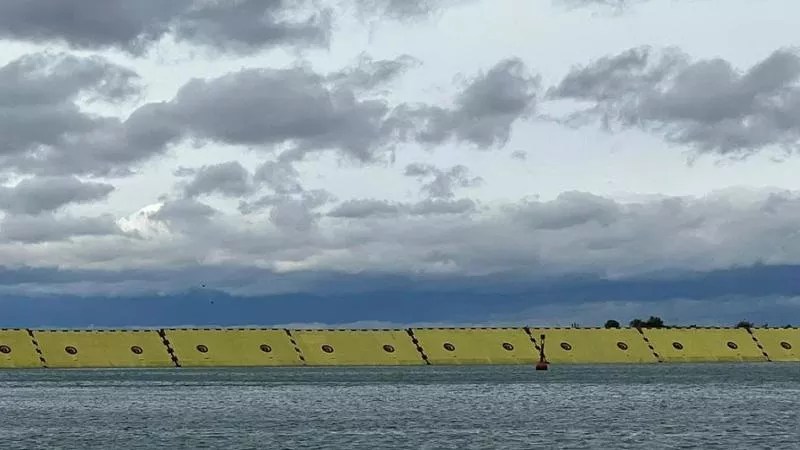
The raising of MoSE – which will continue to be repeated in the coming days, with high tide levels expected to be significant tomorrow too – has already cost over 2 million euros from October 18 to date. However, beyond this accounting for the engineering, how much has the economic system in Venice saved in the meantime thanks to the avoided damage from acqua alta events, from commerce to tourism, from the transportation system to all the other links in the production chain in the historic city. While it isn’t possible to produce a precise estimate for such a limited time period, the figure is certainly far higher than the costs of putting the MoSE system into operation, with clear benefits for the life of the city.
CORILA – the Consortium for coordination of research activities concerning the Venice lagoon system – has recently estimated that the direct economic damage caused by acqua alta to the Venetian economic system would range between 211 and 464 million euros annually – excluding the progressive wear of the city’s physical structures – without MoSE in operation. A figure, according to the Consortium, destined to triple in the next thirty years without the use of the system of mobile dams at the port inlets.
Considering that very high or exceptional high tides are generally only concentrated in certain months of the year, it is therefore not far-fetched to believe that in recent days alone, thanks to MoSE, Venice has saved approximately ten times the expense of putting the dams into operation, i.e. 20 million euro. However, beyond the overall costs of the MOSE, which are now close to 7 billion euros, the system is still in the experimental phase, with an assured lifespan, again according to CORILA, of at least fifty years based on the most recent estimates on the rise of the seas. Thus the problem of a precise analysis of the costs and benefits of the system for Venice arises, also considering the request for annual state funds that will be necessary to guarantee maintenance and the system’s efficiency, while waiting to establish what to do next to continue protecting the city and its lagoon.
Even an economist like Professor Renato Brunetta, president of the Venice World Capital of Sustainability Foundation, which was established in recent years to deal with future scenarios that concern the city in light of increasingly evident climate change, is convinced of this.
“It is a task that will fall to the new president of the Lagoon Authority – comments Brunetta – who is about to be appointed and who will have to estimate not only the costs of the maintenance and functioning of MoSE – also with respect, for example, to partial closures of the system – but also the benefits regarding its impact on the life of the city, which far exceed the former. The benefits are not just the ones specifically concerning the prevention of economic damage to the entire Venetian production system, which is finally protected from the exceptional high tides. But there are also systemic benefits that concern the life of the city itself. Let’s just think about the heritage and real estate value of Venice, destined to collapse if the city becomes permanently prey to exceptional high tides. Or the functionality of the Port. There are also benefits to the social and residential base of the city, which is already in difficulty in the current situation. Venice would be destined to rapidly depopulate, as has already happened to other cities hit by catastrophic events, such as repeated earthquakes.”
According to Brunetta, the effective protection by MoSE – which starting next year should be raised for tides of one meter and 10 centimeters lower above average sea level compared to the current meter and 20 – is also changing the international perception of Venice as a very fragile city destined to succumb to rising seas.
“There is great curiosity and at the same time admiration for the MoSE – explains Brunetta – and even recently the French ambassador to Italy conveyed to me his enthusiasm for the effective functioning of the work, which was evidently not taken for granted”.
-Source: La Nuova di Venezia e Mestre
 Campaign For A Living Venice