
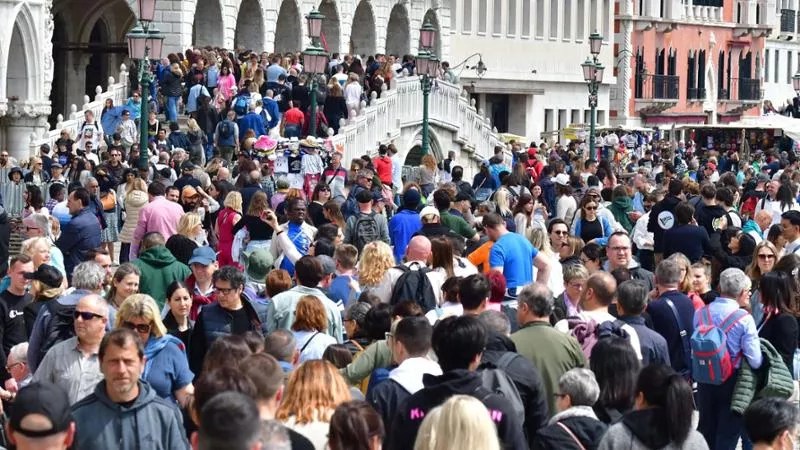
The city counts 40,000 visitors a day and less than 50,000 residents: with an average of 5,048 tourists per square kilometer the historic center of Venice is the most densely populated area in the entire region.
October 14, 2023
By Laura Berlinghieri
Over 5,000 tourists per square kilometer: some kind of crowd, you might say. And that’s exactly how it is: it’s a snapshot of Venice. Of the Rialto Bridge and Piazza San Marco, of Lista di Spagna and Riva degli Schiavoni, to mention the most crowded places – the most crowded in Veneto, in fact. Because with an average of 5,048 tourists per square kilometer the historic center of Venice is the most densely populated area in the entire region.
This is largely the “fault” of short-term rentals: without which, in fact, the figure would drop to 3,845 tourists per square km. Still a large number, and in fact Venice would remain at the top of the “ranking” even in this case, but certainly with more breathing room.
To illustrate the magnitude of these figures, it’s enough to think about the fact that the location in Veneto which is the second most densely “inhabited” by tourists is Cavallino-Treporti, which, however, counts an average of “just” 410 tourists per square km.
This is nothing new. In Venice they have talked about overtourism, that is excessive and destructive tourism, for years. It was discussed on Thursday in Rimini, with the presentation of a report dedicated to this phenomenon, carried out by the consulting company Sociometrica on behalf of Federalberghi Veneto and its president Massimiliano Schiavon.
It says that Lazise is the Veneto municipality with the highest ratio of tourists to residents, equal to 1.5. This means that, for even 100 citizens, the city that overlooks Lake Garda welcomes an average of 150 tourists. Using real data: 7,000 inhabitants and 14,000 temporary presences.
In second place is Cavallino-Treporti (1.4) and then Bibione (1.3). Venice is only ninth, but the reason is simple, the municipality also includes the mainland. For the rest, tourist overcrowding reigns supreme in the lagoon. Think of the recent warning from UNESCO, which threatened to insert the city in the list of Endangered Sites, also because of overtourism.
For this reason, the administration has decided to take a countermeasure, introducing – starting next spring and only for a few days, on an experimental basis – a mandatory reservation with an entry ticket of 5 Euro. So UNESCO was convinced and “forgave” Venice, withdrawing the threat.
However, the phenomenon of overtourism remains, with all of its consequences. Especially in a fragile city like Venice. Moreover, the collapse of tourism during the years of the Covid pandemic represented one of the heaviest blows to the region’s economy.
Veneto continues to focus strongly on the tourism sector, as demonstrated by the increase in total beds available to tourists between 2014 and 2022: there were 214,317, now become 314,710, an increase of 0.3%. Paradoxically the number of rooms has decreased, from 112,012 to 109,724, while the number of hotels grew from 3,055 to 3,146.
This is not surprising, for a sector highly focused on quantity, and this is what the Venetians of the historic center are contesting. Over 14 million tourists pass through here every year. This means that the average is 40,000 a day, for a city that has now fallen below the symbolic threshold of 50,000 residents. The surface area of the city is among the smallest in Veneto: just 7.8 square kilometers. This helps illustrate the enormous figure which quantifies the extent of overtourism in the city of water. It’s a phenomenon that needs to be stopped: this will be the great challenge for the city’s future.
Source: La Nuova di Venezia e Mestre
 Campaign For A Living Venice
Hearing about over tourism in Venice is absolutely nothing new. What would be new was to hear some sensible ideas to allow more people to live and work in the city in affordable property. Instead of the almost unenforceable €5 levy why not tax overseas’ individuals and companies at a high rate and insist on a minimum term of occupancy to avoid it? That would at least be a start and also raise more revenue than the utterly daft levy which is not much more than the price of a coffee to most tourists and less than a beer.
LikeLike